Skip to main content
GOB Chemistry
My Course
Learn
Exam Prep
AI Tutor
Study Guides
Textbook Solutions
Flashcards
Explore
Try the app
My Course
Learn
Exam Prep
AI Tutor
Study Guides
Textbook Solutions
Flashcards
Explore
Try the app
Back
Glycerophospholipids quiz
You can tap to flip the card.
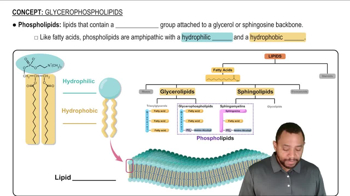
What structural feature makes phospholipids amphipathic?
You can tap to flip the card.
👆
What structural feature makes phospholipids amphipathic?
They have a hydrophilic (polar) head and a hydrophobic (nonpolar) tail.
Track progress
Control buttons has been changed to "navigation" mode.
1/15
Related flashcards
Related practice
Recommended videos
Glycerophospholipids definitions
Glycerophospholipids
15 Terms
Glycerophospholipids
23. Lipids
6 problems
Topic
Ernest
Sphingomyelins
23. Lipids
3 problems
Topic
Nicole
23. Lipids - Part 1 of 3
6 topics
13 problems
Chapter
Ernest
23. Lipids - Part 2 of 3
6 topics
12 problems
Chapter
Nicole
23. Lipids - Part 3 of 3
1 topic
3 problems
Chapter
Guided course
2:05
Glycerophospholipids Concept 1
2967
views
1
rank
Guided course
1:56
Glycerophospholipids Concept 2
2887
views
3
rank
Guided course
1:09
Glycerophospholipids Example 2
2899
views
1
rank
Terms in this set (15)
Hide definitions
What structural feature makes phospholipids amphipathic?
They have a hydrophilic (polar) head and a hydrophobic (nonpolar) tail.
What are the two possible backbones for phospholipids?
Phospholipids can have either a glycerol or a sphingosine backbone.
How do phospholipids arrange themselves in an aqueous environment?
They form a lipid bilayer with polar heads facing outward and hydrophobic tails facing inward.
What is the main function of phospholipids in cells?
They are major components of cell membranes, forming the structural basis of the lipid bilayer.
What are glycerophospholipids also known as?
Glycerophospholipids are also called phosphoglycerides.
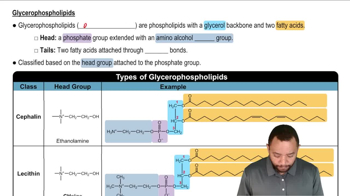
What are the main components of a glycerophospholipid?
A glycerol backbone, two fatty acids, and a phosphate group extended with an amino alcohol head group.
How are the fatty acids attached to the glycerol backbone in glycerophospholipids?
They are attached through ester bonds.
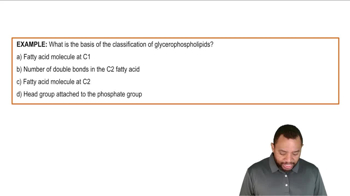
On what basis are glycerophospholipids classified?
They are classified based on the type of head group attached to the phosphate group.
What is the head group in cefillin?
The head group in cefillin is ethanolamine.
What is the head group in lecithin?
The head group in lecithin is choline.
What distinguishes the choline head group in lecithin from ethanolamine in cefillin?
Choline has methyl groups instead of hydrogens attached to the nitrogen.
Can the fatty acid chains in glycerophospholipids be saturated or unsaturated?
Yes, the fatty acid chains can be either saturated or unsaturated.
What is the most abundant type of lipid in cell membranes?
Glycerophospholipids are the most abundant lipids in cell membranes.
What part of the glycerophospholipid determines its classification?
The type of head group attached to the phosphate group determines its classification.
What is the role of the alcohol group in the head group of glycerophospholipids?
The alcohol group bonds to the phosphate group, forming the head region of the molecule.
 BackBack

 2:05
2:05