Skip to main content
GOB Chemistry
My Course
Learn
Exam Prep
AI Tutor
Study Guides
Textbook Solutions
Flashcards
Explore
Try the app
My Course
Learn
Exam Prep
AI Tutor
Study Guides
Textbook Solutions
Flashcards
Explore
Try the app
Back
Glycolysis Summary definitions
You can tap to flip the card.
Glycolysis
You can tap to flip the card.
👆
Glycolysis
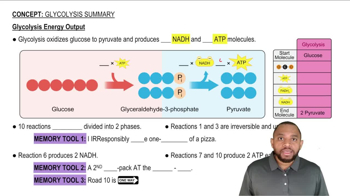
A metabolic pathway that splits glucose into pyruvate, yielding a net gain of two ATP and two NADH without releasing carbon dioxide.
Track progress
Control buttons has been changed to "navigation" mode.
1/15
Related flashcards
Related practice
Recommended videos
Glycolysis Summary quiz
Glycolysis Summary
15 Terms
Glycolysis Summary
22. Carbohydrate Metabolism
5 problems
Topic
Laura
Pyruvate Oxidation
22. Carbohydrate Metabolism
3 problems
Topic
Nicole
22. Carbohydrate Metabolism
9 topics
15 problems
Chapter
Nicole
Guided course
3:14
Glycolysis Summary Concept 1
2970
views
2
rank
Guided course
1:24
Glycolysis Summary Example 2
2864
views
1
rank
Guided course
2:30
Glycolysis Summary Concept 2
2932
views
2
rank
Terms in this set (15)
Hide definitions
Glycolysis
A metabolic pathway that splits glucose into pyruvate, yielding a net gain of two ATP and two NADH without releasing carbon dioxide.
Phase A
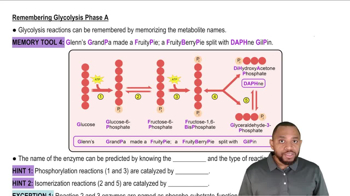
The initial five reactions of glycolysis, requiring two ATP investment and including two irreversible phosphorylation steps.
Phase B
The final five reactions of glycolysis, generating four ATP and two NADH, and ending with the formation of pyruvate.
ATP
A molecule produced and consumed during glycolysis, serving as the main energy currency in cellular processes.
NADH
An energetic molecule generated in glycolysis, specifically in reaction 6, which carries electrons for further energy production.
Pyruvate
The three-carbon end product of glycolysis, formed in an irreversible reaction and serving as a key metabolic intermediate.
Phosphorylation
A chemical process in glycolysis where a phosphate group is added to a substrate, often using ATP, catalyzed by kinases.
Isomerization
A reaction type in glycolysis where a molecule is converted into its isomer, typically catalyzed by isomerases.
Kinase
An enzyme class in glycolysis responsible for transferring phosphate groups, crucial in both phosphorylation and dephosphorylation steps.
Isomerase
An enzyme that catalyzes the rearrangement of atoms within a molecule, facilitating isomerization reactions in glycolysis.
Dehydrogenase
An enzyme that catalyzes oxidation reactions in glycolysis, notably producing NADH by transferring electrons.
Aldolase
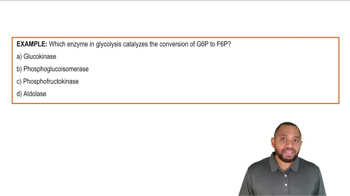
An enzyme that catalyzes bond cleavage in glycolysis, splitting a six-carbon sugar into two three-carbon molecules.
Enolase
An enzyme that catalyzes dehydration reactions in glycolysis, removing water to form a high-energy intermediate.
Mutase
An enzyme that shifts a functional group within a molecule, such as moving a phosphate group to a different position in glycolysis.
Irreversible Reaction
A step in glycolysis that proceeds in only one direction, ensuring pathway commitment and regulation, such as reactions 1, 3, and 10.
 BackBack
 3:14
3:14