Back

Heat Capacity quiz

Control buttons has been changed to "navigation" mode.
1/15
  • What is the relationship between heat (q) and temperature change (ΔT)?

    Heat is directly proportional to temperature change; as more heat is applied, the temperature change increases.
  • How is heat capacity (C) defined?

    Heat capacity is the amount of heat required to change the temperature of a substance by a certain amount.
  • What does specific heat capacity (c) measure?

    Specific heat capacity measures the amount of heat required to change the temperature of 1 gram of a substance by 1 degree (Kelvin or Celsius).
  • What is the formula for specific heat capacity?

    The formula is c = q / (m * ΔT), where q is heat, m is mass in grams, and ΔT is the temperature change.
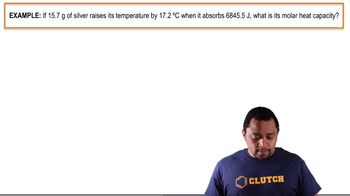
  • What does molar heat capacity (C) refer to?

    Molar heat capacity is the amount of heat required to change the temperature of 1 mole of a substance by 1 degree (Kelvin or Celsius).
  • What is the formula for molar heat capacity?

    The formula is C = q / (n * ΔT), where q is heat, n is moles, and ΔT is the temperature change.
  • Why must the units of temperature in calculations match the units in heat capacity values?

    The units must match to ensure the calculation is correct and consistent, whether using Kelvin or Celsius.
  • What does the variable 'q' represent in heat capacity equations?

    'q' represents the amount of heat absorbed or released.
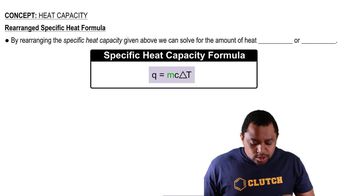
  • In the formula q = m * c * ΔT, what does each variable represent?

    q is heat, m is mass in grams, c is specific heat capacity, and ΔT is the temperature change.
  • What mnemonic can help you remember the specific heat formula?

    The mnemonic 'MCAT' helps remember the formula q = m * c * ΔT.
  • How do you determine which temperature unit to use in calculations?

    Use the temperature unit (Kelvin or Celsius) that matches the units in the specific or molar heat capacity value.
  • What is the difference between specific heat capacity and molar heat capacity?

    Specific heat capacity is per gram of substance, while molar heat capacity is per mole of substance.
  • What are the typical units for specific heat capacity?

    Specific heat capacity is usually in joules per gram per degree Celsius (J/g·°C) or joules per gram per Kelvin (J/g·K).
  • What are the typical units for molar heat capacity?

    Molar heat capacity is usually in joules per mole per degree Celsius (J/mol·°C) or joules per mole per Kelvin (J/mol·K).
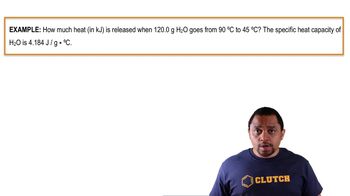
  • How can you calculate the amount of heat absorbed or released in a chemical reaction?

    Use the formula q = m * c * ΔT, where you multiply mass, specific heat capacity, and temperature change.