Back

Heat Capacity definitions

Control buttons has been changed to "navigation" mode.
1/13
  • Heat Capacity

    Amount of heat needed to change the temperature of a substance, typically measured in joules per degree Celsius or Kelvin.
  • Specific Heat Capacity

    Heat required to raise the temperature of 1 gram of a substance by 1 degree, using units like J/g·°C or J/g·K.
  • Molar Heat Capacity

    Heat needed to increase the temperature of 1 mole of a substance by 1 degree, measured in J/mol·°C or J/mol·K.
  • Joule

    Standard unit of energy used to quantify heat in calculations involving temperature changes.
  • Gram

    Metric unit of mass used when calculating specific heat capacity for substances.
  • Mole

    Quantity representing Avogadro's number of particles, used in molar heat capacity calculations.
  • Degree Celsius

    Temperature scale commonly used in heat capacity calculations, interchangeable with Kelvin for temperature differences.
  • Kelvin

    Absolute temperature scale used in scientific calculations, especially for heat capacity.
  • Temperature Change

    Difference between final and initial temperatures, directly proportional to heat applied.
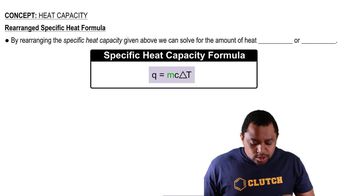
  • Q

    Symbol representing the amount of heat absorbed or released in a process.
  • Delta T

    Symbol for temperature change, calculated as final temperature minus initial temperature.
  • MCAT

    Mnemonic for the formula Q = M × c × ΔT, aiding memory for calculating heat transfer.
  • Proportionality

    Relationship where one quantity increases or decreases in direct relation to another, such as heat and temperature change.