GOB Chemistry
My Course
Learn
Exam Prep
AI Tutor
Study Guides
Textbook Solutions
Flashcards
Explore
My Course
Learn
Exam Prep
AI Tutor
Study Guides
Textbook Solutions
Flashcards
Explore
Back
Hydrohalogenation Reaction definitions
You can tap to flip the card.
Define:
Hydrohalogenation
You can tap to
flip the card.
👆
Hydrohalogenation
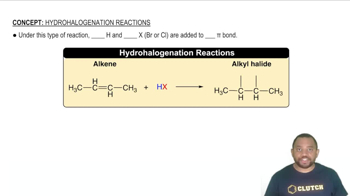
A reaction where one hydrogen and one halogen are added across a pi bond, converting alkenes or alkynes into alkyl halides.
Track progress
Control buttons has been changed to "navigation" mode.
1/13
Related practice
Recommended videos
Guided course
0:56
Hydrohalogenation Reaction Concept 1
Jules
1670
views
2
rank
Guided course
0:36
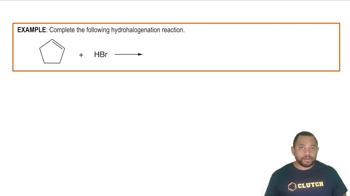
Hydrohalogenation Reaction Example 1
Jules
1541
views
4
rank
Guided course
1:37
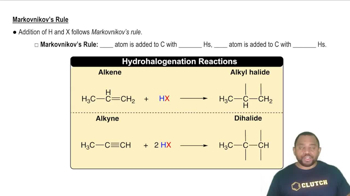
Markovnikov's Rule Concept 2
Jules
1127
views
2
rank
Terms in this set (13)
Hide definitions
Hydrohalogenation
A reaction where one hydrogen and one halogen are added across a pi bond, converting alkenes or alkynes into alkyl halides.
Alkene
A hydrocarbon containing at least one carbon-carbon double bond, serving as a typical starting material in these reactions.
Alkyne
A hydrocarbon with at least one carbon-carbon triple bond, requiring two equivalents of HX for complete reaction.
Pi Bond
A type of covalent bond found in double or triple bonds, targeted for addition in these transformations.
Halogen
An element such as bromine or chlorine that attaches to a carbon atom during the reaction, forming part of the product.
Hydrogen
An atom added to one of the double- or triple-bonded carbons during the process, following specific regioselectivity.
Alkyl Halide
The product formed when a hydrogen and a halogen are added to an alkene or alkyne, replacing a pi bond.
Markovnikov's Rule
A guideline stating that hydrogen attaches to the carbon with more hydrogens, while the halogen attaches to the one with fewer.
Symmetrical Alkene
A molecule where both double-bonded carbons have the same number of hydrogens, allowing non-selective addition.
Non-symmetrical Alkene
A molecule with double-bonded carbons having different numbers of hydrogens, requiring regioselective addition.
Dihalide
A compound formed when two halogen atoms are added to the same carbon in an alkyne after reaction with two equivalents of HX.
Regioselectivity
A preference for the addition of atoms to specific positions on a molecule, as dictated by Markovnikov's rule.
HX
A general formula representing a hydrogen halide, such as HBr or HCl, used as a reagent in these reactions.