Back

Hydrohalogenation Reaction quiz

Control buttons has been changed to "navigation" mode.
1/15
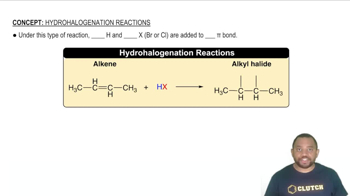
  • What is added to a pi bond in a hydrohalogenation reaction?

    One hydrogen atom and one halogen atom (bromine or chlorine) are added to a pi bond.
  • What type of product is formed from a hydrohalogenation reaction?

    An alkyl halide is formed as the product.
  • In a symmetrical alkene, how is the addition of hydrogen and halogen determined?

    The hydrogen and halogen can add to either of the double-bonded carbons without preference.
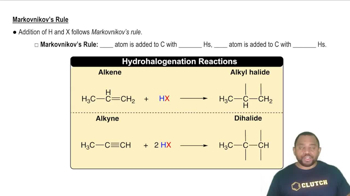
  • What rule is used to determine the addition pattern in non-symmetrical alkenes or alkynes?

    Markovnikov's rule is used to determine the addition pattern.
  • According to Markovnikov's rule, to which carbon does the hydrogen atom add?

    The hydrogen atom adds to the carbon with more hydrogens already attached.
  • According to Markovnikov's rule, to which carbon does the halogen atom add?

    The halogen atom adds to the carbon with fewer hydrogens.
  • What is the general reactant and reagent in a hydrohalogenation reaction?

    The reactant is an alkene or alkyne, and the reagent is HX (where X is a halogen).
  • How many moles of HX are required to fully react with an alkyne?

    Two moles of HX are required because an alkyne has two pi bonds.
  • What is the product called when two halogens are added to an alkyne?

    The product is called a dihalide.
  • Where do both halogen atoms add in the hydrohalogenation of an alkyne?

    Both halogen atoms add to the same carbon that had fewer hydrogens.
  • What determines whether you need to use Markovnikov's rule in a hydrohalogenation reaction?

    You use Markovnikov's rule if the double or triple bonded carbons have a different number of hydrogens.
  • What is the main difference in product formation between symmetrical and non-symmetrical alkenes in hydrohalogenation?

    Symmetrical alkenes can form products with the halogen on either carbon, while non-symmetrical alkenes follow Markovnikov's rule for product formation.
  • What is the initial reactant structure in a hydrohalogenation reaction?

    The initial reactant is an alkene or alkyne with a pi bond.
  • What is the final product structure after hydrohalogenation of an alkene?

    The final product is an alkyl halide with the halogen and hydrogen added across the former double bond.
  • Why do alkynes require two additions of HX in hydrohalogenation?

    Alkynes have two pi bonds, so two moles of HX are needed to fully saturate the molecule and form a dihalide.