Back

Intro to Addition Reactions definitions

Control buttons has been changed to "navigation" mode.
1/13
  • Alkene

    A hydrocarbon containing at least one carbon-carbon double bond, featuring both a sigma and a pi bond.
  • Alkyne

    A hydrocarbon with at least one carbon-carbon triple bond, consisting of one sigma and two pi bonds.
  • Addition Reaction

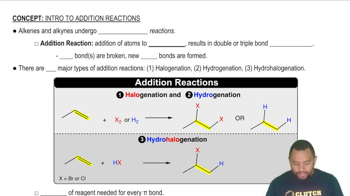
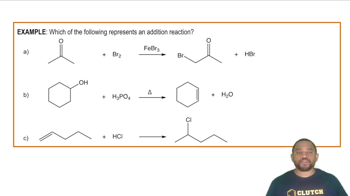
    A process where atoms are added to pi bonds, breaking double or triple bonds and forming new sigma bonds.
  • Pi Bond

    A type of bond formed from the sideways overlap of p orbitals, present in double and triple bonds.
  • Sigma Bond

    A strong bond formed by the direct overlap of orbitals, always present in single, double, and triple bonds.
  • Halogenation

    A reaction where halogen atoms are added to a pi bond, resulting in the formation of a dihalide.
  • Hydrogenation

    A reaction involving the addition of hydrogen atoms to a pi bond, converting alkenes into alkanes.
  • Hydrohalogenation

    A reaction where both a hydrogen and a halogen are added to a double bond, producing an alkyl halide.
  • Dihalide

    A compound formed when two halogen atoms are added across a double bond during halogenation.
  • Alkyl Halide

    A molecule resulting from the addition of a hydrogen and a halogen to an alkene, containing a halogen atom bonded to carbon.
  • Reagent

    A substance used to cause a chemical reaction, with one mole required for each pi bond in addition reactions.
  • Double Bond

    A chemical bond consisting of one sigma and one pi bond, found in alkenes.
  • Triple Bond

    A chemical bond made up of one sigma and two pi bonds, characteristic of alkynes.