Back

Intro to Coenzymes quiz

Control buttons has been changed to "navigation" mode.
1/15
  • What subclass of enzymes are dehydrogenases part of?

    Dehydrogenases are a subclass of oxidoreductases.
  • What do dehydrogenases require to become active?

    Dehydrogenases require coenzymes to become active.
  • What are the three components of ATP?

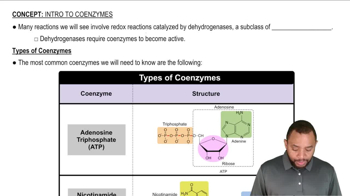
    ATP is composed of an adenine nitrogenous base, a ribose sugar, and three phosphates.
  • What is the ADP portion found in many coenzymes?

    The ADP portion stands for adenosine diphosphate and is a common structural component in several coenzymes.
  • What unique group does NAD+ contain after the ADP portion?

    NAD+ contains a CH2 group, a ribosugar, and a nicotinamide nitrogen portion after the ADP portion.
  • What are the three main components of FAD?

    FAD is made up of adenosine diphosphate, ribitol (an alcohol), and flavin.
  • What are the three main components of Coenzyme A?

    Coenzyme A contains adenosine diphosphate, pantothenic acid, and aminoethanethiol.
  • In which metabolic cycle are NAD+ and FAD especially important?

    NAD+ and FAD are especially important in the Citric Acid Cycle.
  • What is produced from NAD+ and FAD during food catabolism?

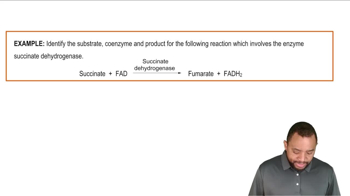
    NADH and FADH2 are produced from NAD+ and FAD during food catabolism.
  • Where do redox reactions typically occur on coenzymes?

    Redox reactions typically occur at the unique groups attached to the ADP portion of coenzymes.
  • Which coenzymes have structures that are considered too complex for core study?

    The structures of vitamin B12 coenzyme and coenzyme Q are considered too complex for core study.
  • Why is it important to know about coenzymes B12 and Q even if their structures are not detailed?

    It is important because they are also common and significant types of coenzymes in biological reactions.
  • What is the function of coenzymes in dehydrogenase-catalyzed reactions?

    Coenzymes function as essential participants in redox reactions catalyzed by dehydrogenases.
  • What color is used to highlight the sites of redox reactions on coenzymes in diagrams?

    A mustard color is used to highlight the sites of redox reactions on coenzymes.
  • What is the significance of the unique groups attached to the ADP portion in coenzymes?

    The unique groups determine the specific function and site of redox activity for each coenzyme.