Back

Intro to Cofactors definitions

Control buttons has been changed to "navigation" mode.
1/12
  • Cofactor

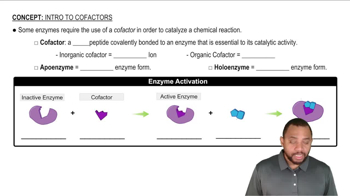
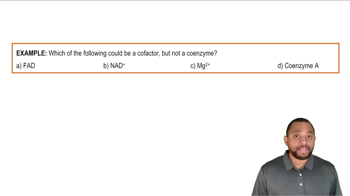
    A non-peptide molecule, either inorganic or organic, covalently bonded to an enzyme and essential for its catalytic function.
  • Coenzyme

    An organic molecule, often containing carbon, that serves as a cofactor and assists enzymes in catalysis.
  • Metallic Ion

    An inorganic ion, such as magnesium, that acts as a cofactor to help enzymes perform catalytic reactions.
  • Apoenzyme

    An inactive enzyme form lacking its required cofactor, unable to catalyze reactions until activation.
  • Holoenzyme

    An active enzyme form resulting from the binding of a cofactor to an apoenzyme, enabling catalysis.
  • Enzyme Activation

    The process where a cofactor binds to an apoenzyme, converting it into its active form capable of catalysis.
  • Active Site

    A specific region on an enzyme where the substrate binds, its shape often optimized by cofactor attachment.
  • Substrate

    A molecule that interacts with an enzyme's active site, undergoing transformation during a catalytic reaction.
  • Enzyme-Substrate Complex

    A temporary structure formed when a substrate fits into an enzyme's active site, enabling the reaction.
  • Catalytic Activity

    The ability of an enzyme, often requiring a cofactor, to accelerate chemical reactions.
  • Inorganic Cofactor

    A non-carbon-containing molecule, typically a metal ion, that assists enzymes in catalysis.
  • Organic Cofactor

    A carbon-containing molecule, also known as a coenzyme, required for enzyme activation.