Back

Intro to Cofactors quiz

Control buttons has been changed to "navigation" mode.
1/15
  • What is a cofactor in the context of enzymes?

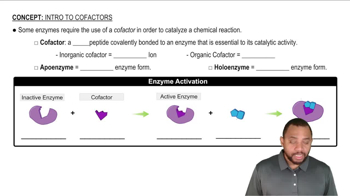
    A cofactor is a non-peptide molecule covalently bonded to an enzyme that is essential for its catalytic activity.
  • What are the two main types of cofactors?

    Cofactors can be inorganic (such as metallic ions) or organic (called coenzymes).
  • What is an inorganic cofactor?

    An inorganic cofactor is a metallic ion, like a magnesium ion.
  • What is an organic cofactor called?

    An organic cofactor is called a coenzyme.
  • What is an apoenzyme?

    An apoenzyme is the inactive form of an enzyme, lacking its necessary cofactor.
  • What is a holoenzyme?

    A holoenzyme is the active form of an enzyme, which includes its cofactor.
  • How does a cofactor activate an enzyme?

    A cofactor attaches to the apoenzyme, converting it into a holoenzyme and activating the enzyme.
  • What happens to the substrate binding when a cofactor is present?

    The substrate fits better into the enzyme's active site when the cofactor is present, facilitating binding.
  • What is formed when an enzyme and substrate bind together?

    When an enzyme and substrate bind, they form an enzyme-substrate complex.
  • Do all enzymes require cofactors to function?

    No, only some enzymes require cofactors to become active and catalyze reactions.
  • What is the role of a cofactor in enzyme catalysis?

    A cofactor is essential for the catalytic activity of certain enzymes.
  • How does the presence of a cofactor affect the enzyme's active site?

    The cofactor changes the enzyme's active site so the substrate can fit and bind more effectively.
  • What is the difference between a cofactor and a coenzyme?

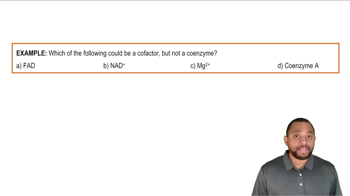
    A coenzyme is a type of organic cofactor, while cofactors can be either inorganic or organic.
  • What is the initial state of an enzyme that requires a cofactor?

    The initial state is the inactive apoenzyme, which becomes active upon cofactor binding.
  • Why is the enzyme-substrate complex important?

    The enzyme-substrate complex is necessary for the enzyme to catalyze a chemical reaction.