Skip to main content
GOB Chemistry
My Course
Learn
Exam Prep
AI Tutor
Study Guides
Textbook Solutions
Flashcards
Explore
Try the app
My Course
Learn
Exam Prep
AI Tutor
Study Guides
Textbook Solutions
Flashcards
Explore
Try the app
Back
Intro to Gluconeogenesis definitions
You can tap to flip the card.
Gluconeogenesis
You can tap to flip the card.
👆
Gluconeogenesis
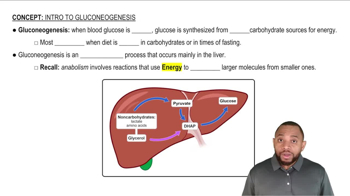
An anabolic liver process synthesizing glucose from non-carbohydrate sources, especially active during fasting or low carbohydrate intake.
Track progress
Control buttons has been changed to "navigation" mode.
1/14
Related flashcards
Related practice
Recommended videos
Intro to Gluconeogenesis quiz
Intro to Gluconeogenesis
15 Terms
Intro to Gluconeogenesis
22. Carbohydrate Metabolism
2 problems
Topic
Nicole
Gluconeogenesis
22. Carbohydrate Metabolism
5 problems
Topic
Nicole
22. Carbohydrate Metabolism
9 topics
15 problems
Chapter
Nicole
Guided course
1:31
Intro to Gluconeogenesis Example 1
1300
views
2
rank
Guided course
1:45
Intro to Gluconeogenesis Concept 1
1356
views
Guided course
1:03
Intro to Gluconeogenesis Concept 2
1336
views
Terms in this set (14)
Hide definitions
Gluconeogenesis
An anabolic liver process synthesizing glucose from non-carbohydrate sources, especially active during fasting or low carbohydrate intake.
Glucose
A primary energy molecule essential for brain function, produced from carbohydrates or synthesized when dietary intake is insufficient.
Non-carbohydrate Sources
Molecules like lactate, amino acids, and glycerol that can be converted into glucose when dietary carbohydrates are scarce.
Liver
The main organ where anabolic synthesis of glucose from non-carbohydrate precursors occurs during gluconeogenesis.
Anabolism
A set of energy-consuming reactions that build larger molecules, such as glucose, from smaller precursors.
Lactate
A non-carbohydrate molecule that can be converted into pyruvate, serving as a precursor for glucose synthesis.
Amino Acids
Building blocks of proteins that can be transformed into pyruvate, contributing to glucose formation during fasting.
Pyruvate
A central metabolic intermediate formed from lactate or amino acids, which can be converted into DHAP in gluconeogenesis.
Dihydroxyacetone Phosphate
A metabolic intermediate, abbreviated as DHAP, formed from pyruvate or glycerol, leading to glucose synthesis.
Glycerol
A non-carbohydrate precursor derived from fats, converted into DHAP and then used for glucose production.
Glycolysis
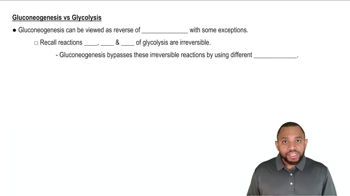
A metabolic pathway that breaks down glucose into pyruvate through ten reactions, some of which are irreversible.
Irreversible Reactions
Specific steps in glycolysis that cannot proceed in reverse, requiring alternative enzymes in gluconeogenesis.
Enzymes
Biological catalysts that facilitate metabolic reactions, including those that bypass irreversible glycolytic steps in gluconeogenesis.
Blood Glucose Levels
The concentration of glucose in the bloodstream, which regulates the activity of gluconeogenic enzymes.
 BackBack
 1:31
1:31