Back

Intro to Nucleic Acids quiz

Control buttons has been changed to "navigation" mode.
1/15
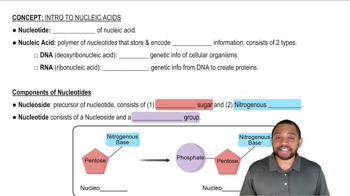
  • What is a nucleotide?

    A nucleotide is a monomer or single unit of a nucleic acid.
  • What is a nucleic acid?

    A nucleic acid is a polymer of nucleotides that stores and encodes genetic information.
  • What are the two types of nucleic acids?

    The two types are DNA (deoxyribonucleic acid) and RNA (ribonucleic acid).
  • What is the main function of DNA?

    DNA stores the genetic information of cellular organisms.
  • What is the main function of RNA?

    RNA transfers genetic information from DNA to create proteins.
  • What is a nucleoside?

    A nucleoside is a precursor to a nucleotide and consists of a pentose sugar and a nitrogenous base.
  • What are the three components of a nucleotide?

    A nucleotide is made up of a phosphate group, a pentose sugar, and a nitrogenous base.
  • How is a nucleotide different from a nucleoside?

    A nucleotide has a phosphate group in addition to the pentose sugar and nitrogenous base found in a nucleoside.
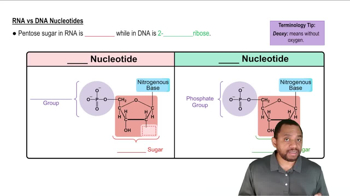
  • What is the pentose sugar in RNA nucleotides?

    The pentose sugar in RNA nucleotides is ribose.
  • What is the pentose sugar in DNA nucleotides?

    The pentose sugar in DNA nucleotides is 2-deoxy ribose.
  • What does 'deoxy' mean in deoxyribose?

    'Deoxy' means without oxygen, indicating the absence of an -OH group.
  • What is the key structural difference between ribose and deoxyribose?

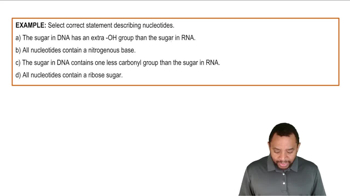
    Ribose has an -OH group, while deoxyribose lacks this -OH group and has just an H.
  • Which nucleotide contains an -OH group on its pentose sugar?

    RNA nucleotides contain an -OH group on their ribose sugar.
  • Which nucleotide lacks an -OH group on its pentose sugar?

    DNA nucleotides lack an -OH group on their deoxyribose sugar.
  • What are the three key terms to remember when discussing nucleotides?

    The three key terms are phosphate group, pentose sugar, and nitrogenous base.