Back

Ions and the Octet Rule definitions

Control buttons has been changed to "navigation" mode.
1/15
  • Octet Rule

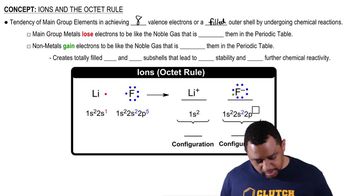
    Guideline stating that main group elements seek eight electrons in their outer shell for enhanced stability, similar to noble gases.
  • Valence Electrons

    Electrons located in the outermost shell of an atom, crucial for determining chemical reactivity and bonding.
  • Noble Gas

    Element with a completely filled outer electron shell, resulting in high stability and minimal chemical reactivity.
  • Cation

    Positively charged species formed when an atom loses one or more electrons, often seen in metals.
  • Anion

    Negatively charged species formed when an atom gains one or more electrons, commonly found in non-metals.
  • Electron Configuration

    Arrangement of electrons in an atom’s shells and subshells, dictating chemical properties and reactivity.
  • Subshell

    Subdivision within an electron shell, labeled as s or p, each with a specific electron capacity.
  • Shell Number

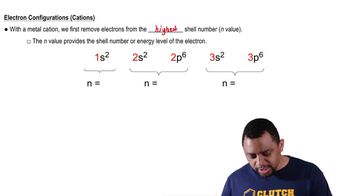
    Principal quantum number (n) indicating the energy level and distance of electrons from the nucleus.
  • Stability

    Condition achieved when an atom has a filled outer shell, resulting in low chemical reactivity.
  • Chemical Reactivity

    Tendency of an atom to undergo chemical changes, often reduced when the outer shell is filled.
  • Main Group Element

    Element found in groups 1, 2, and 13–18 of the periodic table, typically following the octet rule.
  • Metal

    Element that tends to lose electrons to achieve a stable electron configuration, forming cations.
  • Non-metal

    Element that tends to gain electrons to achieve a stable electron configuration, forming anions.
  • Energy Level

    Specific region around the nucleus where electrons are likely to be found, associated with a shell number.
  • Preceding Noble Gas

    Noble gas located before a main group metal in the periodic table, serving as the electron configuration goal after electron loss.