Back

Isotopes quiz

Control buttons has been changed to "navigation" mode.
1/15
  • What is an isotope?

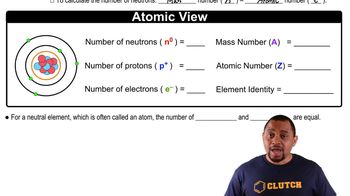
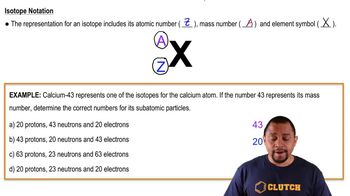
    An isotope is an element with the same number of protons but a different number of neutrons.
  • What does the atomic number (Z) represent?

    The atomic number represents the number of protons in an element.
  • How can you determine the identity of an element using the atomic number?

    You can look up the atomic number on the periodic table to find the element's identity.
  • What is the mass number (A) of an atom?

    The mass number is the sum of the protons and neutrons in an atom.
  • How do you calculate the number of neutrons in an atom?

    Subtract the atomic number (Z) from the mass number (A) to get the number of neutrons.
  • Where are protons and neutrons located in an atom?

    Protons and neutrons are located in the nucleus of the atom.
  • Where are electrons found in an atom?

    Electrons orbit around the nucleus of the atom.
  • In the example given, how many protons, neutrons, and electrons does the atom have?

    The atom has 5 protons, 6 neutrons, and 5 electrons.
  • What is the atomic number of boron?

    The atomic number of boron is 5.
  • What is the mass number of the boron atom in the example?

    The mass number is 11 (5 protons + 6 neutrons).
  • What makes an atom electrically neutral?

    An atom is neutral when it has equal numbers of protons and electrons.
  • What is another term for a neutral element?

    A neutral element is often called an atom.
  • What happens to the charge of an atom if protons and electrons are not equal?

    The atom becomes an ion, which has a net positive or negative charge.
  • What is the significance of the atomic number in determining chemical properties?

    The atomic number helps determine the element's identity and its chemical properties.
  • What is the relationship between protons and electrons in a neutral atom?

    In a neutral atom, the number of protons equals the number of electrons.