Skip to main content
GOB Chemistry
My Course
Learn
Exam Prep
AI Tutor
Study Guides
Textbook Solutions
Flashcards
Explore
Try the app
My Course
Learn
Exam Prep
AI Tutor
Study Guides
Textbook Solutions
Flashcards
Explore
Try the app
Back
Ka and Kb definitions
You can tap to flip the card.
Monoprotic Acid
You can tap to flip the card.
👆
Monoprotic Acid
A substance capable of donating only one hydrogen ion per molecule during ionization in water.
Track progress
Control buttons has been changed to "navigation" mode.
1/13
Related flashcards
Related practice
Recommended videos
Ka and Kb quiz
Ka and Kb
15 Terms
Ka and Kb
10. Acids and Bases
4 problems
Topic
Jules
The pH Scale
10. Acids and Bases
6 problems
Topic
Ernest
10. Acids and Bases - Part 1 of 3
6 topics
15 problems
Chapter
Jules
10. Acids and Bases - Part 2 of 3
8 topics
13 problems
Chapter
Jules
10. Acids and Bases - Part 3 of 3
1 topic
3 problems
Chapter
Guided course
03:50
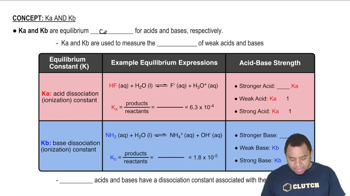
Characteristics of Ka and Kb
3351
views
11
rank
Guided course
01:31
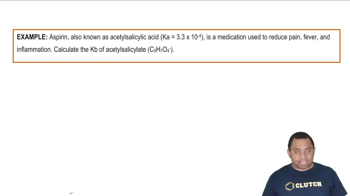
Ka and Kb Example
115
views
Guided course
03:01
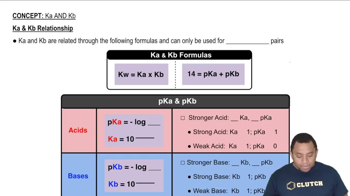
Ka and Kb Relationship
3268
views
7
rank
Terms in this set (13)
Hide definitions
Monoprotic Acid
A substance capable of donating only one hydrogen ion per molecule during ionization in water.
Ionization
The process by which a molecule forms ions in solution, often involving transfer of a hydrogen ion to water.
Equilibrium Expression
A mathematical ratio of product concentrations to reactant concentrations, excluding liquids and solids.
Acid Dissociation Constant
A value representing the extent to which a weak acid ionizes in water, denoted as Ka.
Base Dissociation Constant
A value representing the extent to which a weak base ionizes in water, denoted as Kb.
Hydronium Ion
A positively charged ion formed when water accepts a hydrogen ion, represented as H3O+.
Conjugate Acid
A species formed when a base gains a hydrogen ion during a chemical reaction.
Kw
The ion product constant for water, equal to the product of Ka and Kb.
pKa
A logarithmic measure of acid strength, calculated as the negative log of Ka; lower values indicate stronger acids.
pKb
A logarithmic measure of base strength, calculated as the negative log of Kb.
Strong Acid
A substance with a high Ka value and a low or negative pKa, indicating nearly complete ionization.
Weak Acid
A substance with a Ka value less than 1 and a pKa greater than 1, indicating partial ionization.
Equilibrium Position
The side of a chemical reaction where the weaker, more stable acid or base predominates.
 BackBack

 03:50
03:50