GOB Chemistry
My Course
Learn
Exam Prep
AI Tutor
Study Guides
Textbook Solutions
Flashcards
Explore
My Course
Learn
Exam Prep
AI Tutor
Study Guides
Textbook Solutions
Flashcards
Explore
Back
Le Chatelier's Principle definitions
You can tap to flip the card.
Define:
Chemical Equilibrium
You can tap to
flip the card.
👆
Chemical Equilibrium
A state where the rates of the forward and reverse reactions are equal, resulting in constant concentrations of reactants and products.
Track progress
Control buttons has been changed to "navigation" mode.
1/15
Related practice
Recommended videos
Guided course
07:32
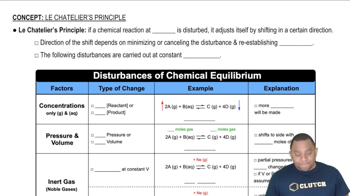
Le Chatelier's Principle
Jules
21
views
Guided course
02:50
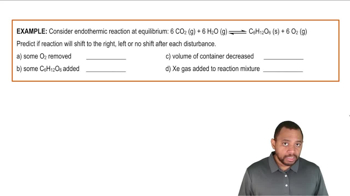
Disturbances and Equilibrium Shifts Example
Jules
18
views
Guided course
03:00
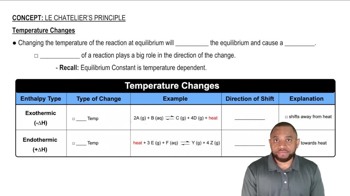
Temperature and Equilibrium Shifts
Jules
18
views
Terms in this set (15)
Hide definitions
Chemical Equilibrium
A state where the rates of the forward and reverse reactions are equal, resulting in constant concentrations of reactants and products.
Disturbance
Any change in conditions such as concentration, pressure, volume, or temperature that disrupts a reaction at equilibrium.
Reactant
A substance present at the start of a chemical reaction, which can be increased or decreased to affect equilibrium.
Product
A substance formed as a result of a chemical reaction, whose amount can influence the direction of equilibrium shift.
Pressure
A force exerted by gas particles in a reaction vessel, influencing equilibrium by favoring the side with fewer or more gas moles.
Volume
The space available for a reaction, inversely related to pressure, affecting the direction of equilibrium shifts in gaseous systems.
Inert Gas
A chemically nonreactive gas, such as a noble gas, whose addition can alter equilibrium only under constant pressure.
Noble Gas
A group of inert elements, like neon, that do not participate in chemical reactions but can affect equilibrium under certain conditions.
Catalyst
A substance that lowers activation energy, increasing reaction rates without altering the position of equilibrium.
Enthalpy
A thermodynamic quantity, represented as delta H, indicating whether a reaction absorbs or releases heat.
Equilibrium Constant
A temperature-dependent value, symbolized as K, expressing the ratio of product to reactant concentrations at equilibrium.
Exothermic Process
A reaction where heat is released, resulting in a negative enthalpy change and heat being considered a product.
Endothermic Process
A reaction where heat is absorbed, resulting in a positive enthalpy change and heat being considered a reactant.
Partial Pressure
The individual pressure exerted by a specific gas in a mixture, relevant when considering inert gas effects on equilibrium.
Mole
A unit representing the amount of a substance, used to compare quantities of gases on each side of a chemical equation.