Back

Molecular Formula definitions

Control buttons has been changed to "navigation" mode.
1/13
  • Molecular Formula

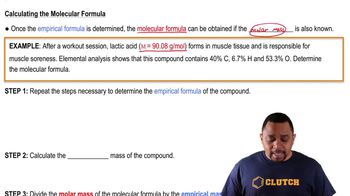
    Shows the actual count of each atom type present in a compound, reflecting its true chemical composition.
  • Empirical Formula

    Represents the simplest whole-number ratio of atoms of each element in a compound, not the actual numbers.
  • Subscript

    A small number written below and to the right of a chemical symbol, indicating the quantity of atoms in a formula.
  • N Factor

    A multiplication value applied to the empirical formula's subscripts to obtain the molecular formula.
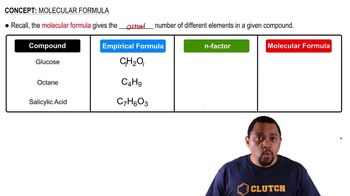
  • Glucose

    A compound with a molecular formula derived by multiplying its empirical formula by an n factor of 6.
  • Octane

    A compound whose molecular formula results from doubling the subscripts in its empirical formula.
  • Salicylic Acid

    A compound where the empirical and molecular formulas are identical due to an n factor of 1.
  • Element

    A pure substance consisting of only one type of atom, represented by a unique chemical symbol.
  • Compound

    A substance formed from two or more elements chemically bonded in fixed proportions.
  • Ratio

    A comparative value expressing the relative quantities of different atoms in a formula.
  • Chemical Composition

    The specific arrangement and quantity of elements that make up a substance.
  • Whole-Number Ratio

    A proportional relationship between atoms in a formula, expressed using integers only.
  • Chemical Symbol

    A one- or two-letter abbreviation representing an element in a chemical formula.