Skip to main content
GOB Chemistry
My Course
Learn
Exam Prep
AI Tutor
Study Guides
Textbook Solutions
Flashcards
Explore
Try the app
My Course
Learn
Exam Prep
AI Tutor
Study Guides
Textbook Solutions
Flashcards
Explore
Try the app
Back
Naming Alcohols quiz
You can tap to flip the card.
What functional group is present in all alcohols?
You can tap to flip the card.
👆
What functional group is present in all alcohols?
Alcohols contain a hydroxyl (OH) group attached to an sp3 hybridized carbon.
Track progress
Control buttons has been changed to "navigation" mode.
1/15
Related flashcards
Related practice
Recommended videos
Naming Alcohols definitions
Naming Alcohols
12 Terms
Naming Alcohols
14. Compounds with Oxygen or Sulfur
7 problems
Topic
Jules
14. Compounds with Oxygen or Sulfur
7 topics
15 problems
Chapter
Jules
Guided course
3:21
Naming Alcohols Example 1
2266
views
18
rank
Guided course
1:10
Alcohol Classification Concept 2
2141
views
5
rank
Guided course
0:43
Alcohol Classification Example 2
2005
views
4
rank
Terms in this set (15)
Hide definitions
What functional group is present in all alcohols?
Alcohols contain a hydroxyl (OH) group attached to an sp3 hybridized carbon.
How is the suffix of an alkane name modified when naming an alcohol?
The suffix 'e' in the alkane name is changed to 'ol' to indicate the presence of an alcohol.
What is the modifier for alcohols when naming them?
The modifier is the change of the alkane suffix from 'e' to 'ol' due to the hydroxyl group.
Why must the location of the OH group be specified in the name of an alcohol?
The location must be specified to indicate which carbon the OH group is attached to, as this affects the compound's identity.
What information must be included when naming an alcohol?
You must include the locations of all substituents and the OH group, and modify the alkane suffix to 'ol'.
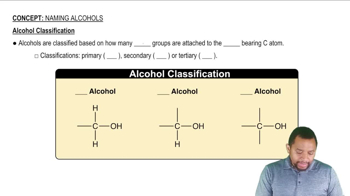
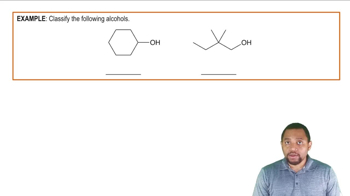
How are alcohols classified based on the carbon attached to the OH group?
Alcohols are classified as primary, secondary, or tertiary depending on whether the OH-bearing carbon is attached to one, two, or three other carbons.
What is a primary alcohol?
A primary alcohol has the OH group attached to a carbon that is connected to only one other carbon.
What is a secondary alcohol?
A secondary alcohol has the OH group attached to a carbon that is connected to two other carbons.
What is a tertiary alcohol?
A tertiary alcohol has the OH group attached to a carbon that is connected to three other carbons.
Do methyl alcohols fit into the primary, secondary, or tertiary classification?
No, methyl alcohols do not fit into these classifications; they are considered a separate category.
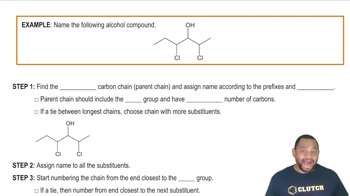
What is the parent chain in alcohol nomenclature?
The parent chain is the longest continuous chain of carbons that includes the carbon bonded to the OH group.
How do you indicate the position of the OH group in the alcohol's name?
You use a number before the 'ol' suffix to show which carbon the OH group is attached to.
What are substituents in the context of alcohol nomenclature?
Substituents are branch groups attached to the main carbon chain, and their positions must be specified in the name.
Why is it important to number the carbon chain when naming alcohols?
Numbering ensures the OH group and any substituents are assigned the lowest possible numbers for clarity and consistency.
What is the general rule for naming alcohols with multiple substituents?
List the positions and names of all substituents, specify the position of the OH group, and change the suffix to 'ol'.
 BackBack
 3:21
3:21