GOB Chemistry
My Course
Learn
Exam Prep
AI Tutor
Study Guides
Textbook Solutions
Flashcards
Explore
My Course
Learn
Exam Prep
AI Tutor
Study Guides
Textbook Solutions
Flashcards
Explore
Back
Naming Alkenes quiz
You can tap to flip the card.
Define:
What is the key structural feature that distinguishes alkenes from alkanes?
You can tap to flip the card.
👆
What is the key structural feature that distinguishes alkenes from alkanes?
Alkenes have at least one carbon-carbon double bond, while alkanes have only single bonds.
Track progress
Control buttons has been changed to "navigation" mode.
1/15
Related flashcards
Related practice
Recommended videos
Naming Alkenes definitions
Naming Alkenes
13 Terms
Naming Alkenes
13. Alkenes, Alkynes, and Aromatic Compounds
5 problems
Topic

Jules
13. Alkenes, Alkynes, and Aromatic Compounds - Part 1 of 2
6 topics
15 problems
Chapter
Jules
13. Alkenes, Alkynes, and Aromatic Compounds - Part 2 of 2
7 topics
15 problems
Chapter
Jules
Guided course
2:47
Rules for Naming Alkenes Concept 1
Jules
2640
views
7
rank
Guided course
3:26
Naming Alkenes Example 1
Jules
2495
views
9
rank
Terms in this set (15)
Hide definitions
What is the key structural feature that distinguishes alkenes from alkanes?
Alkenes have at least one carbon-carbon double bond, while alkanes have only single bonds.
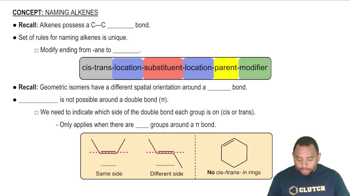
How is the name of an alkane modified to indicate the presence of a double bond?
The ending '-ane' is changed to '-ene' to indicate a double bond, forming the name of an alkene.
What must be specified in the nomenclature of alkenes besides the parent chain?
The location of the double bond and the positions of any substituents must be specified.
Why do geometric isomers exist in alkenes?
Geometric isomers exist because rotation is restricted around the double bond due to its pi bond nature.
What terms are used to describe the relative positions of groups around a double bond in alkenes?
The terms 'cis' and 'trans' are used to describe the relative positions of groups around the double bond.
When are the cis and trans notations applicable in alkenes?
Cis and trans notations are used only when exactly two groups are attached to the carbons forming the double bond.
How do you determine if an alkene is cis or trans?
If the two groups are on the same side of the double bond, it is cis; if on opposite sides, it is trans.
What is the significance of the 'border' in determining cis/trans isomerism?
The border is an imaginary line through the double-bonded carbons, used to compare the positions of attached groups.
What is a geometric isomer in the context of alkenes?
A geometric isomer is a compound with the same molecular formula and connections but different spatial orientation around the double bond.
Can cis/trans notation be used for cyclic alkenes?
No, cis/trans notation is not used for cyclic alkenes due to the structural constraints of the ring.
Why is rotation not possible around a double bond in alkenes?
Rotation is not possible because the pi bond locks the atoms in place, preventing free rotation.
What happens if more than two groups are attached to the double-bonded carbons in an alkene?
Cis/trans notation cannot be used; other naming conventions like E/Z are required.
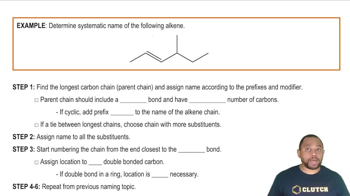
What is the parent chain in alkene nomenclature?
The parent chain is the longest continuous chain containing the double bond.
How do you indicate the position of the double bond in the name of an alkene?
The position is indicated by the lowest-numbered carbon involved in the double bond.
What is the difference between a cis-alkene and a trans-alkene?
In a cis-alkene, the groups are on the same side of the double bond; in a trans-alkene, they are on opposite sides.