Back

Naming Ionic Compounds definitions

Control buttons has been changed to "navigation" mode.
1/14
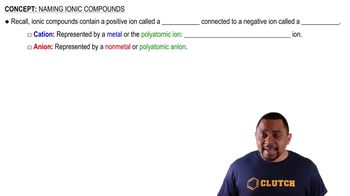
  • Ionic Compound

    A substance formed from the electrostatic attraction between a positive ion and a negative ion.
  • Cation

    A positively charged ion, often a metal or the ammonium ion, written first in a compound's name.
  • Anion

    A negatively charged ion, typically a nonmetal or a polyatomic ion, named second in a compound.
  • Polyatomic Ion

    A charged group of covalently bonded atoms acting as a single ion in compounds.
  • Roman Numeral

    A symbol used in names to indicate the specific positive charge of a metal with multiple possible charges.
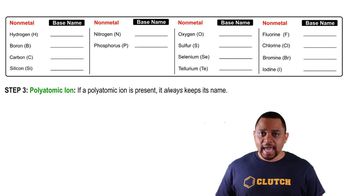
  • Base Name

    The unchanged portion at the start of a nonmetal's name, used before adding the 'ide' ending.
  • Suffix

    An ending added to the base name of a nonmetal, such as 'ide', to form the anion's name.
  • Transition Metal

    A metal element that can have more than one possible positive charge, often requiring a Roman numeral.
  • Main Group Element

    An element from groups 1A to 8A, usually with a single predictable charge in compounds.
  • Ammonium

    A polyatomic ion with the formula NH4+, serving as a common positive ion in compounds.
  • Phosphate

    A polyatomic ion with a negative charge, retaining its full name when part of a compound.
  • Nitrate

    A polyatomic ion with a negative charge, keeping its name unchanged in compound naming.
  • Charge

    The electrical property, positive or negative, that determines how ions combine in compounds.
  • Halogen

    A group 7A nonmetal element, forming anions with base names like chlor, brom, or iod.