Back

Naming Monoatomic Anions definitions

Control buttons has been changed to "navigation" mode.
1/14
  • Monoatomic Anion

    A negatively charged ion formed from a single nonmetal atom by gaining electrons.
  • Systematic Naming

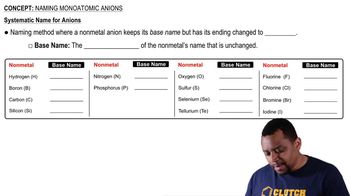
    A method that modifies the ending of a nonmetal's name to 'ide' while keeping its base name.
  • Base Name

    The unchanged initial part of a nonmetal's name used as the root in anion naming.
  • Negative Charge

    An electrical property resulting from an excess of electrons in an ion.
  • Nonmetal

    An element typically found on the right side of the periodic table, often forming anions.
  • Periodic Table

    A chart organizing elements by atomic number, highlighting nonmetals used in anion naming.
  • Hydride

    The anion formed when hydrogen gains an electron, named using the 'ide' suffix.
  • Chloride

    The anion derived from chlorine, named by attaching 'ide' to its base name.
  • Suffix

    A word ending, such as 'ide', added to the base name to indicate an anion.
  • Electron Gain

    The process by which a nonmetal atom acquires extra electrons to become an anion.
  • Phosphide

    The anion formed from phosphorus, named by combining its base name with 'ide'.
  • Oxide

    The anion resulting from oxygen, named by adding 'ide' to its base name.
  • Bromide

    The anion created from bromine, following the systematic naming rule.
  • Iodide

    The anion produced from iodine, named by appending 'ide' to its base name.