Back

Nitrogenous Bases definitions

Control buttons has been changed to "navigation" mode.
1/14
  • Pyrimidine

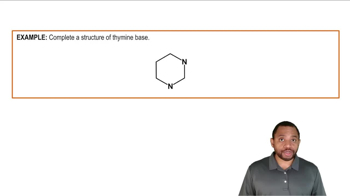
    Single-ringed molecule serving as the base structure for cytosine, thymine, and uracil, each with specific functional group modifications.
  • Purine

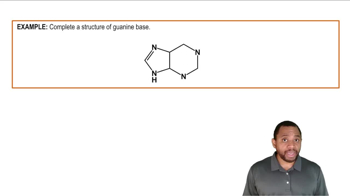
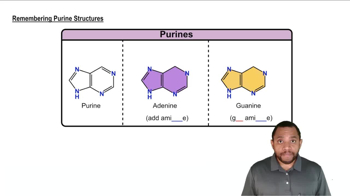
    Double-ringed molecule forming the foundation for adenine and guanine, containing four nitrogen atoms within the rings.
  • Cytosine

    Pyrimidine derivative featuring one carbonyl group and one amine group (NH2) attached to the ring.
  • Thymine

    Pyrimidine derivative similar to uracil but distinguished by an additional methyl group on the ring.
  • Uracil

    Pyrimidine base with two carbonyl groups and two nitrogens, each nitrogen forming a third bond with hydrogen.
  • Adenine

    Purine derivative with an amine group (NH2) attached to the ring, modifying the base purine structure.
  • Guanine

    Purine derivative containing both a carbonyl group and an amine group (NH2) on the fused ring system.
  • Methyl Group

    Functional group consisting of one carbon and three hydrogens, present in thymine but absent in uracil.
  • Amine Group

    Functional group composed of a nitrogen atom bonded to two hydrogens (NH2), found in cytosine, adenine, and guanine.
  • Carbonyl Group

    Functional group featuring a carbon atom double-bonded to an oxygen, present in uracil, thymine, cytosine, and guanine.
  • Single Ring

    Structural feature of pyrimidines, consisting of one six-membered ring with embedded nitrogen atoms.
  • Double Ring

    Structural feature of purines, consisting of two fused rings with four nitrogen atoms.
  • DNA

    Genetic material containing thymine as a pyrimidine base, distinguishing it from RNA.
  • RNA

    Genetic material containing uracil as a pyrimidine base, replacing thymine found in DNA.