Back

Nucleoside and Nucleotide Formation definitions

Control buttons has been changed to "navigation" mode.
1/13
  • Glycosidic Bond

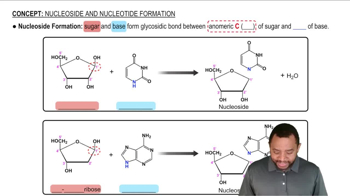
    A covalent linkage formed between the anomeric carbon of a sugar and the nitrogen of a nitrogenous base, resulting from a condensation reaction.
  • Anomeric Carbon

    The specific carbon atom in a sugar (carbon number 1) that forms a bond with a nitrogenous base during nucleoside formation.
  • Nitrogenous Base

    A molecule containing nitrogen that pairs with a sugar to form nucleosides and nucleotides, such as adenine or uracil.
  • Pentose Ring

    A five-membered sugar structure, either ribose or 2'-deoxyribose, serving as the backbone for nucleosides and nucleotides.
  • Ribose

    A pentose sugar with an OH group on carbon number two, found in RNA nucleosides and nucleotides.
  • 2'-Deoxyribose

    A pentose sugar lacking an OH group on carbon number two, characteristic of DNA nucleosides and nucleotides.
  • Condensation Reaction

    A chemical process where two molecules join, releasing water as a byproduct, crucial for forming glycosidic and phosphate bonds.
  • Phosphate Group

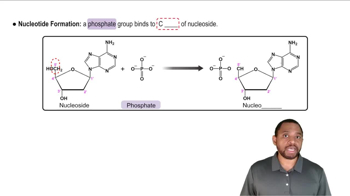
    A chemical group that attaches to the 5' carbon of a nucleoside, completing the structure of a nucleotide.
  • Nucleoside

    A compound consisting of a pentose ring bonded to a nitrogenous base, lacking a phosphate group.
  • Nucleotide

    A molecule composed of a phosphate group, a pentose ring, and a nitrogenous base, forming the building blocks of nucleic acids.
  • 5' Carbon

    The fifth carbon atom in a pentose ring, serving as the attachment site for the phosphate group in nucleotide formation.
  • Purine

    A type of nitrogenous base with a double-ring structure, such as adenine, found in nucleosides and nucleotides.
  • Uracil

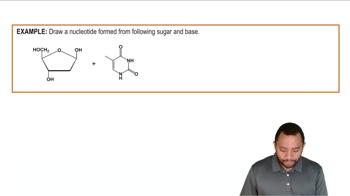
    A single-ring nitrogenous base found in RNA, which forms nucleosides through bonding with ribose.