Back

Periodic Table: Elemental Forms (Simplified) definitions

Control buttons has been changed to "navigation" mode.
1/13
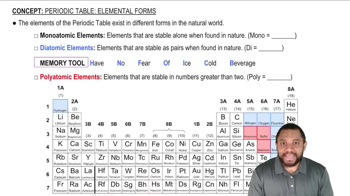
  • Monoatomic Element

    A substance found in nature as single, unpaired atoms, such as lithium, magnesium, or zinc.
  • Diatomic Element

    A substance naturally stable as a pair of identical atoms, like H2, N2, O2, F2, Cl2, Br2, or I2.
  • Polyatomic Element

    A substance naturally stable as a group of more than two identical atoms, such as P4, S8, or Se8.
  • Periodic Table

    A chart organizing elements by atomic number and properties, revealing patterns in elemental forms.
  • Group

    A vertical column on the periodic table where elements share similar chemical properties.
  • Chemical Property

    A characteristic that determines how an element behaves or reacts with other substances.
  • Stability

    A condition where an element exists in its most natural, unreactive form, such as monoatomic, diatomic, or polyatomic.
  • Phosphorus

    A polyatomic element naturally found as a cluster of four atoms bonded together.
  • Sulfur

    A polyatomic element naturally found as a ring of eight atoms bonded together.
  • Selenium

    A polyatomic element, similar to sulfur, naturally found as a group of eight atoms.
  • Hydrogen

    A diatomic element, most stable in nature as a molecule of two identical atoms.
  • Mnemonic

    A memory aid, such as 'have no fear of ice cold beer,' used to recall diatomic elements.
  • Atomic Structure

    The arrangement of atoms in an element, determining if it is monoatomic, diatomic, or polyatomic.