GOB Chemistry
My Course
Learn
Exam Prep
AI Tutor
Study Guides
Textbook Solutions
Flashcards
Explore
My Course
Learn
Exam Prep
AI Tutor
Study Guides
Textbook Solutions
Flashcards
Explore
Back
Periodic Table: Main Group Element Charges definitions
You can tap to flip the card.
Define:
Noble Gas
You can tap to
flip the card.
👆
Noble Gas
Element in Group 8A with a stable, fully filled outer electron shell and zero charge, serving as the electron configuration goal for other elements.
Track progress
Control buttons has been changed to "navigation" mode.
1/15
Related practice
Recommended videos
Periodic Table: Main Group Element Charges
3. Ionic Compounds
3 problems
Topic

Jules
3. Ionic Compounds - Part 1 of 2
5 topics
9 problems
Chapter
Jules
3. Ionic Compounds - Part 2 of 2
6 topics
9 problems
Chapter
Jules
Guided course
02:15
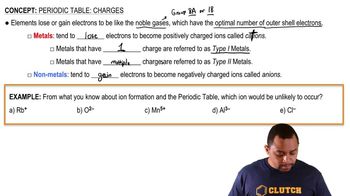
Periodic Table: Main Group Element Charges Concept 1
Jules
8382
views
67
rank
Guided course
01:52
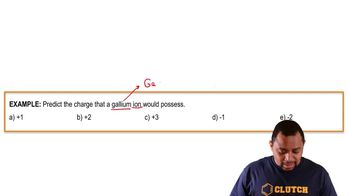
Periodic Table: Main Group Element Charges Example 1
Jules
6978
views
66
rank
Guided course
07:38
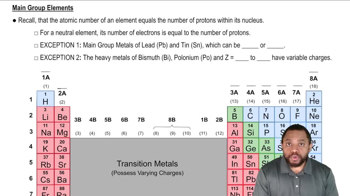
Periodic Table: Main Group Element Charges Concept 2
Jules
7925
views
65
rank
Terms in this set (15)
Hide definitions
Noble Gas
Element in Group 8A with a stable, fully filled outer electron shell and zero charge, serving as the electron configuration goal for other elements.
Cation
Positively charged ion formed when an atom loses electrons, commonly associated with metals in the periodic table.
Anion
Negatively charged ion resulting from an atom gaining electrons, typically found among nonmetals.
Main Group Element
Element located in Groups 1A to 8A (1–2, 13–18), exhibiting predictable ionic charges based on group position.
Transition Metal
Element found in the grayed-out central block of the periodic table, often with variable ionic charges, discussed separately from main groups.
Atomic Number
Value representing the number of protons in an atom's nucleus, determining the element's identity and electron count when neutral.
Type 1 Metal
Metal that forms only one specific positive ionic charge, simplifying its chemical behavior.
Type 2 Metal
Metal capable of forming multiple positive ionic charges, often requiring clarification in compound naming.
Metalloid
Element with properties intermediate between metals and nonmetals, often complicating charge prediction.
Electron Configuration
Arrangement of electrons in an atom's shells, influencing chemical reactivity and ion formation.
Group 1A Charge
Typical ionic charge of +1, resulting from the loss of one electron, characteristic of alkali metals.
Group 2A Charge
Typical ionic charge of +2, resulting from the loss of two electrons, characteristic of alkaline earth metals.
Group 3A Charge
Typical ionic charge of +3, resulting from the loss of three electrons, common among metals below boron.
Group 5A Charge
Typical ionic charge of -3, resulting from the gain of three electrons, characteristic of nonmetals in this group.
Group 6A Charge
Typical ionic charge of -2, resulting from the gain of two electrons, common among oxygen and sulfur.