GOB Chemistry
My Course
Learn
Exam Prep
AI Tutor
Study Guides
Textbook Solutions
Flashcards
Explore
Try the app
My Course
Learn
Exam Prep
AI Tutor
Study Guides
Textbook Solutions
Flashcards
Explore
Try the app
Back
Periodic Table: Main Group Element Charges quiz
You can tap to flip the card.
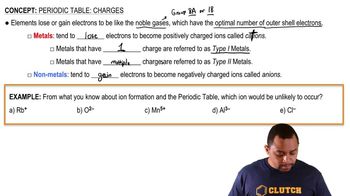
Why do elements in the periodic table gain or lose electrons?
You can tap to flip the card.
👆
Why do elements in the periodic table gain or lose electrons?
Elements gain or lose electrons to achieve a stable electron configuration like the noble gases.
Track progress
Control buttons has been changed to "navigation" mode.
1/15
Related flashcards
Related practice
Recommended videos
Periodic Table: Main Group Element Charges definitions
Periodic Table: Main Group Element Charges
15 Terms
Periodic Table: Main Group Element Charges
3. Ionic Compounds
3 problems
Topic

Jules
3. Ionic Compounds - Part 1 of 2
5 topics
9 problems
Chapter
Jules
3. Ionic Compounds - Part 2 of 2
6 topics
9 problems
Chapter
Jules
Guided course
01:52
Periodic Table: Main Group Element Charges Example 1
8531
views
73
rank
Guided course
07:38
Periodic Table: Main Group Element Charges Concept 2
9419
views
74
rank
Guided course
00:48
Periodic Table: Main Group Element Charges Example 2
7534
views
59
rank
Terms in this set (15)
Hide definitions
Why do elements in the periodic table gain or lose electrons?
Elements gain or lose electrons to achieve a stable electron configuration like the noble gases.
What type of ions do metals typically form?
Metals typically form cations, which are positively charged ions, by losing electrons.
What type of ions do nonmetals typically form?
Nonmetals typically form anions, which are negatively charged ions, by gaining electrons.
What is the typical charge for Group 1A elements?
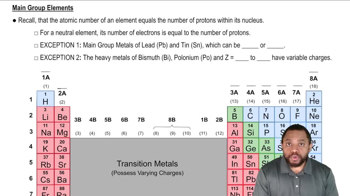
Group 1A elements usually have a +1 charge because they lose one electron.
What is the typical charge for Group 2A elements?
Group 2A elements usually have a +2 charge because they lose two electrons.
What is the typical charge for Group 3A elements?
Group 3A elements usually have a +3 charge because they lose three electrons.
What is the typical charge for Group 5A nonmetals?
Group 5A nonmetals usually have a -3 charge because they gain three electrons.
What is the typical charge for Group 6A nonmetals?
Group 6A nonmetals usually have a -2 charge because they gain two electrons.
What is the typical charge for Group 7A nonmetals?
Group 7A nonmetals usually have a -1 charge because they gain one electron.
Why do noble gases not form ions?
Noble gases have a stable electron configuration and do not need to gain or lose electrons, so their charge is 0.
Why is Group 4A's typical charge considered non-applicable?
Group 4A elements can either lose or gain four electrons, so their typical charge varies and is not fixed.
What are the possible charges for lead (Pb) and tin (Sn)?
Lead and tin can have charges of +2 or +4 due to their properties similar to transition metals.
What is the easiest path for an element to achieve a noble gas configuration?
The easiest path is generally favored, meaning elements lose or gain the fewest electrons possible to match a noble gas.
What is the charge of a neutral atom?
A neutral atom has no charge because its number of protons equals its number of electrons.
What is the main difference between type 1 and type 2 metals?
Type 1 metals have only one possible positive charge, while type 2 metals can have multiple positive charges.