GOB Chemistry
My Course
Learn
Exam Prep
AI Tutor
Study Guides
Textbook Solutions
Flashcards
Explore
Try the app
My Course
Learn
Exam Prep
AI Tutor
Study Guides
Textbook Solutions
Flashcards
Explore
Try the app
Back
Periodic Table: Transition Metal Charges definitions
You can tap to flip the card.
Type 2 Metals
You can tap to flip the card.
👆
Type 2 Metals
Metals, mainly from the transition group, known for exhibiting more than one possible positive charge.
Track progress
Control buttons has been changed to "navigation" mode.
1/13
Related flashcards
Related practice
Recommended videos
Periodic Table: Transition Metal Charges quiz
Periodic Table: Transition Metal Charges
15 Terms
3. Ionic Compounds - Part 1 of 2
5 topics
9 problems
Chapter
Jules
3. Ionic Compounds - Part 2 of 2
6 topics
9 problems
Chapter
Jules
Guided course
01:34
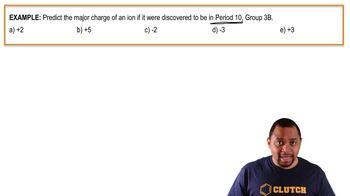
Periodic Table: Transition Metals Charges Example 1
6742
views
40
rank
Guided course
02:22
Periodic Table: Transition Metals Charges Concept 1
9162
views
57
rank
1
comments
Terms in this set (13)
Hide definitions
Type 2 Metals
Metals, mainly from the transition group, known for exhibiting more than one possible positive charge.
Transition Metals
Elements found in the central block of the periodic table, often displaying variable positive charges.
Electron Arrangement
The specific distribution of electrons around an atom's nucleus, influencing possible ionic charges.
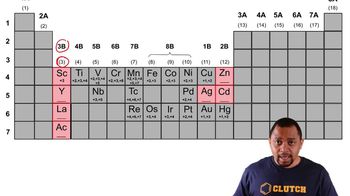
Group 3
A vertical column in the periodic table where elements like scandium consistently show a +3 charge.
Scandium
A transition element in group 3, always forming ions with a +3 charge.
Manganese
A transition element capable of forming ions with charges ranging from +2 to +7.
Silver
A transition element that forms ions with a single, consistent +1 charge.
Cadmium
A transition element that forms ions exclusively with a +2 charge.
Zinc
A transition element, similar to cadmium, always forming ions with a +2 charge.
Ion
An atom or molecule with a net electric charge due to the loss or gain of electrons.
Charge
The electrical property of an ion, determined by the difference between protons and electrons.
Periodic Table
A systematic arrangement of elements, highlighting trends in properties such as possible ionic charges.
Group
A column in the periodic table where elements often share similar chemical properties and charges.