Back

Periodic Table: Transition Metal Charges quiz

Control buttons has been changed to "navigation" mode.
1/15
  • What defines a type 2 metal in terms of its charges?

    Type 2 metals possess multiple possible charges due to their electron arrangements.
  • Why do most transition metals have varying positive charges?

    Their electron arrangements around the nucleus allow for multiple charge states.
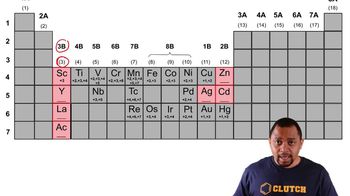
  • Which group does scandium belong to, and what is its typical charge?

    Scandium belongs to group 3 or 3b and typically has a +3 charge.
  • Do all transition metals have multiple charges?

    No, some transition metals have only one specific charge.
  • What is the charge of silver as an ion?

    Silver as an ion has a charge of +1.
  • What are the charges of cadmium and zinc as ions?

    Both cadmium and zinc have a charge of +2 as ions.
  • Are transition metals with only one charge considered type 2 metals?

    No, transition metals with only one charge are not considered type 2 metals.
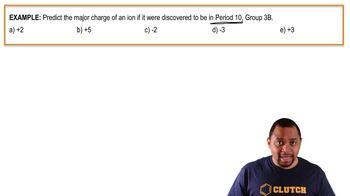
  • What is the typical charge for elements in group 3b?

    Elements in group 3b typically have a +3 charge.
  • How can manganese exhibit different charges?

    Manganese can have charges of +2, +3, +4, +5, or +7 depending on the element it combines with.
  • What characteristic makes transition metals 'transition' metals?

    Transition metals are characterized by having multiple possible charges.
  • How do you determine which charge a transition metal like manganese will have?

    The charge depends on the other element it is connected to.
  • Why are silver, cadmium, and zinc not considered type 2 metals?

    They have only one specific charge and do not exhibit multiple charges.
  • What is the relationship between group membership and charge for scandium, cadmium, and zinc?

    Elements in the same group often have similar charges, like scandium (+3) and cadmium/zinc (+2).
  • What is the main difference between type 2 metals and other transition metals?

    Type 2 metals have multiple possible charges, while some transition metals have only one charge.
  • What should you keep in mind when dealing with different transition metals?

    Some transition metals have multiple charges, while others have only one specific charge.