Back

Periodic Trend: Atomic Radius (Simplified) definitions

Control buttons has been changed to "navigation" mode.
1/15
  • Atomic Radius

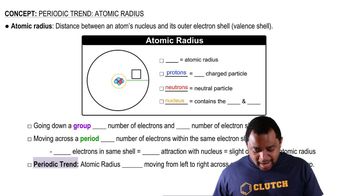
    Distance from the center of an atom's nucleus to its outermost electron shell, indicating the size of the atom.
  • Nucleus

    Central region of an atom containing protons and neutrons, responsible for most of the atom's mass.
  • Valence Shell

    Outermost electron shell of an atom, where the highest-energy electrons are located.
  • Proton

    Positively charged particle found within the nucleus, contributing to atomic number and mass.
  • Neutron

    Neutral particle located in the nucleus, contributing to atomic mass but not charge.
  • Electron Shell

    Energy level surrounding the nucleus where electrons are likely to be found.
  • Period

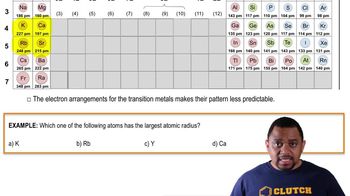
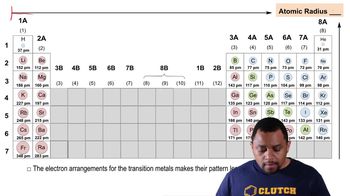
    Horizontal row in the periodic table, where atomic radius generally decreases from left to right.
  • Group

    Vertical column in the periodic table, where atomic radius generally increases from top to bottom.
  • Transition Metal

    Element found in the central block of the periodic table, often showing irregular atomic radius trends.
  • Periodic Table

    Tabular arrangement of elements, organized by atomic number, electron configuration, and recurring properties.
  • Attraction

    Force between the nucleus and electrons, influencing the size of the atomic radius.
  • Electron Arrangement

    Distribution of electrons among an atom's shells, affecting chemical properties and atomic size.
  • Top Right Corner

    Region of the periodic table where elements have the smallest atomic radii due to increased nuclear attraction.
  • Exception

    Case where a general trend does not apply, such as unpredictable atomic radius patterns in transition metals.
  • Picometer

    Unit of length equal to one trillionth of a meter, commonly used to measure atomic radii.