Back

Periodic Trend: Atomic Radius (Simplified) quiz

Control buttons has been changed to "navigation" mode.
1/15
  • What is atomic radius?

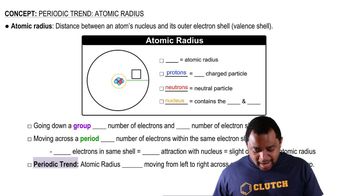
    Atomic radius is the distance between an atom's nucleus and its outermost electron shell (valence shell).
  • What particles are found in the nucleus of an atom?

    The nucleus contains protons, which are positively charged, and neutrons, which are neutral.
  • How does atomic radius change as you move down a group in the periodic table?

    Atomic radius increases as you move down a group because additional electron shells are added.
  • How does atomic radius change as you move from left to right across a period?

    Atomic radius decreases from left to right across a period due to increased attraction between the nucleus and electrons in the same shell.
  • Why does atomic radius decrease across a period?

    It decreases because more electrons are added to the same shell, increasing the attraction to the nucleus and pulling the shell closer.
  • Why does atomic radius increase down a group?

    It increases because each new period adds an additional electron shell, making the atom larger.
  • What is the general trend for atomic radius on the periodic table?

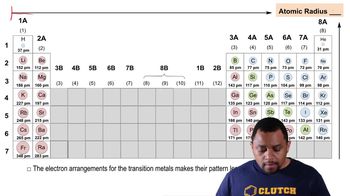
    Atomic radius decreases as you move toward the top right corner of the periodic table.
  • What is the atomic radius of hydrogen?

    Hydrogen has an atomic radius of 37 picometers.
  • What is the atomic radius of lithium?

    Lithium has an atomic radius of 152 picometers.
  • Do you need to memorize the atomic radii of all elements?

    No, you only need to remember the general trend, not the specific values.
  • Why are transition metals often excluded from atomic radius trends?

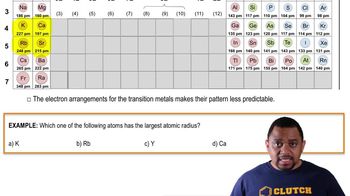
    Transition metals are excluded because their electron arrangements make their atomic radius patterns less predictable.
  • What happens to the number of electron shells as you go down a group?

    The number of electron shells increases as you go down a group.
  • What happens to the number of electrons in the same shell as you move across a period?

    The number of electrons in the same shell increases as you move across a period.
  • What effect does adding more electrons to the same shell have on atomic radius?

    Adding more electrons to the same shell increases attraction to the nucleus, causing the atomic radius to decrease.
  • In which direction on the periodic table does atomic radius decrease most significantly?

    Atomic radius decreases most significantly as you move from the bottom left to the top right of the periodic table.