Back

Periodic Trend: Electron Affinity (Simplified) definitions

Control buttons has been changed to "navigation" mode.
1/14
  • Electron Affinity

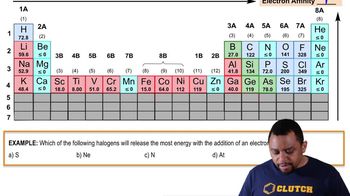
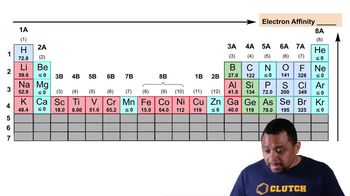
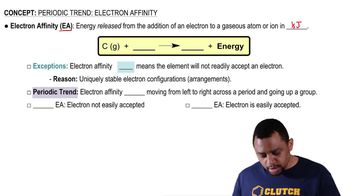
    Energy released when a gaseous atom or ion gains an electron, indicating how easily an atom accepts an extra electron.
  • Gaseous Atom

    An atom in the gas phase, not bonded to other atoms, often used as the reference state for measuring electron affinity.
  • Noble Gases

    Elements with fully filled electron shells, making them electronically perfect and resistant to gaining extra electrons.
  • Stable Electron Configuration

    An arrangement of electrons that provides extra stability, often preventing the acceptance of additional electrons.
  • Negative Charge

    The result when an atom gains an electron, due to the electron's inherent negative nature.
  • Periodic Trend

    A predictable pattern observed across the periodic table, such as the increase or decrease of electron affinity.
  • Group

    A vertical column in the periodic table, where electron affinity generally increases from bottom to top.
  • Period

    A horizontal row in the periodic table, where electron affinity typically increases from left to right.
  • Exception

    A case where the general trend does not apply, such as certain elements with unusual electron affinities.
  • Energy Release

    The emission of energy when an electron is added to an atom, signifying the process of electron affinity.
  • Electron Arrangement

    The specific distribution of electrons in an atom, influencing its tendency to accept additional electrons.
  • Kilojoule

    The unit commonly used to express the energy change associated with electron affinity.
  • Top Right Corner

    The region of the periodic table where elements generally have the highest electron affinities.
  • Electron

    A negatively charged subatomic particle whose addition to an atom is central to the concept of electron affinity.