Back

Periodic Trend: Electron Affinity (Simplified) quiz

Control buttons has been changed to "navigation" mode.
1/15
  • What does electron affinity (EA) represent in chemistry?

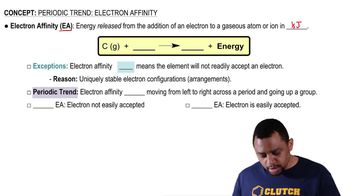
    Electron affinity represents the energy released when an electron is added to a gaseous atom or ion, measured in kilojoules.
  • What happens to the charge of an atom when it gains an electron?

    The atom gains a negative charge because electrons are negatively charged.
  • In the context of electron affinity, is energy absorbed or released when an electron is added to an atom?

    Energy is released when an electron is added to an atom, which is why electron affinity is considered a product.
  • Why do noble gases have electron affinities less than or equal to zero?

    Noble gases have stable electron configurations and do not readily accept additional electrons, resulting in EA values less than or equal to zero.
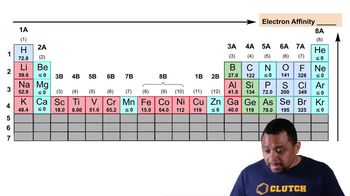
  • What is the general trend for electron affinity across a period in the periodic table?

    Electron affinity generally increases from left to right across a period.
  • How does electron affinity change as you move up a group in the periodic table?

    Electron affinity increases as you move up a group.
  • What does a low electron affinity indicate about an element's tendency to accept electrons?

    A low electron affinity means the element does not easily accept electrons.
  • What does a high electron affinity indicate about an element's reactivity?

    A high electron affinity means the atom or ion will more readily accept an electron.
  • Why is electron affinity considered less straightforward than other periodic trends?

    Electron affinity has many exceptions and does not always follow a simple pattern, especially in rows 5, 6, and 7.
  • Name two groups of elements, besides noble gases, that have low or zero electron affinity.

    Group 2A elements (beryllium, magnesium, calcium) and elements like nitrogen, zinc, and manganese have low or zero electron affinity.
  • What is the electron configuration status of elements with low electron affinity?

    They have stable or perfect electron configurations, making them less likely to accept additional electrons.
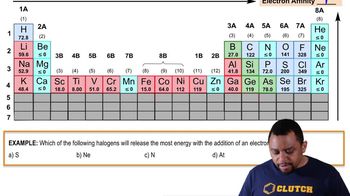
  • Where on the periodic table does electron affinity generally reach its highest values?

    Electron affinity generally increases toward the top right corner of the periodic table.
  • Why do elements like nitrogen, zinc, and manganese have low electron affinities?

    They have stable electronic arrangements, making them less likely to accept electrons.
  • What is the relationship between electron affinity and the ease of electron acceptance?

    The greater the electron affinity, the more easily an atom or ion will accept an electron.
  • Why should students be cautious when applying electron affinity trends to elements in rows 5, 6, and 7?

    There are many exceptions in these rows, making the trend less reliable for those elements.