GOB Chemistry
My Course
Learn
Exam Prep
AI Tutor
Study Guides
Textbook Solutions
Flashcards
Explore
My Course
Learn
Exam Prep
AI Tutor
Study Guides
Textbook Solutions
Flashcards
Explore
Back
Periodic Trend: Ionic Radius (Simplified) definitions
You can tap to flip the card.
Define:
Ionic Radius
You can tap to
flip the card.
👆
Ionic Radius
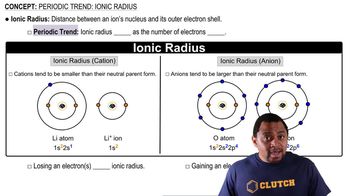
Distance from the nucleus of an ion to its outermost electron shell, influenced by the total number of electrons.
Track progress
Control buttons has been changed to "navigation" mode.
1/13
Related practice
Recommended videos
Guided course
02:47
Periodic Trend: Ionic Radius (Simplified) Concept 1
Jules
5920
views
32
rank
Guided course
01:32
Periodic Trend: Ionic Radius (Simplified) Example 1
Jules
4880
views
19
rank
Terms in this set (13)
Hide definitions
Ionic Radius
Distance from the nucleus of an ion to its outermost electron shell, influenced by the total number of electrons.
Cation
Positively charged species formed by losing electrons, resulting in a smaller size than its neutral counterpart.
Anion
Negatively charged species formed by gaining electrons, resulting in a larger size than its neutral counterpart.
Electron Shell
Energy level surrounding the nucleus where electrons are located; losing or gaining electrons changes its occupancy.
Neutral Atom
Species with equal numbers of protons and electrons, serving as a reference for comparing ionic sizes.
Valence Electron
Electron located in the outermost shell, whose loss or gain determines the charge and size of an ion.
Parent Atom
Original neutral species from which an ion is derived, used for size comparison with its ionic form.
Positive Ion
Species with fewer electrons than protons, resulting in a reduced electron shell and smaller radius.
Negative Ion
Species with more electrons than protons, leading to increased electron repulsion and a larger radius.
Electron Loss
Process that decreases the number of electrons, causing a reduction in ionic radius and formation of a cation.
Electron Gain
Process that increases the number of electrons, causing an expansion in ionic radius and formation of an anion.
Outer Shell
Farthest occupied energy level from the nucleus, its electron count determines the size of the ion.
Periodic Trend
Pattern observed across elements, though not applicable for predicting ionic radius, which depends on electron count.