GOB Chemistry
My Course
Learn
Exam Prep
AI Tutor
Study Guides
Textbook Solutions
Flashcards
Explore
Try the app
My Course
Learn
Exam Prep
AI Tutor
Study Guides
Textbook Solutions
Flashcards
Explore
Try the app
Back
Physical & Chemical Changes quiz
You can tap to flip the card.
What is a physical change in chemistry?
You can tap to flip the card.
👆
What is a physical change in chemistry?
A physical change alters the physical state of a substance without changing its composition or identity.
Track progress
Control buttons has been changed to "navigation" mode.
1/15
Related flashcards
Related practice
Recommended videos
Physical & Chemical Changes definitions
Physical & Chemical Changes
17 Terms
Physical & Chemical Changes
1. Matter and Measurements
4 problems
Topic

Jules
1. Matter and Measurements - Part 1 of 3
7 topics
15 problems
Chapter
Jules
1. Matter and Measurements - Part 2 of 3
7 topics
15 problems
Chapter
Jules
1. Matter and Measurements - Part 3 of 3
7 topics
15 problems
Chapter
Ernest
Guided course
01:52
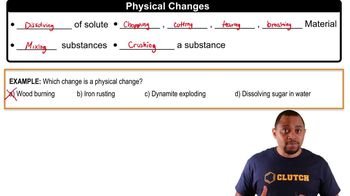
Physical & Chemical Changes Example 2
10593
views
175
rank
Guided course
03:40
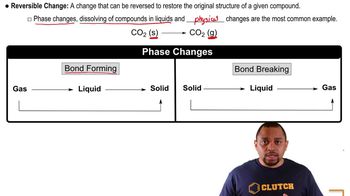
Physical & Chemical Changes
10684
views
166
rank
Guided course
01:52
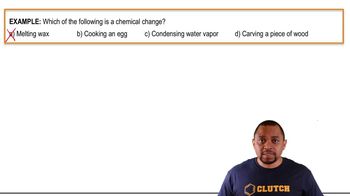
Physical & Chemical Changes Example 1
12996
views
249
rank
Terms in this set (15)
Hide definitions
What is a physical change in chemistry?
A physical change alters the physical state of a substance without changing its composition or identity.
What happens to the identity of a substance during a physical change?
The identity of the original substance remains intact during a physical change.
Give two examples of physical changes.
Examples include dissolving a solute and crushing a soda can.
What is a chemical change?
A chemical change alters the chemical composition and identity of a substance, creating new chemical bonds and products.
Name two common examples of chemical changes.
Rusting of metals and burning materials are common examples of chemical changes.
What visible signs might indicate a chemical change has occurred?
Visible signs include color changes and odor changes.
What is a reversible change in matter?
A reversible change can be undone to restore the original substance, such as phase changes and dissolving.
What is an irreversible change?
An irreversible change permanently alters the original material, making it impossible to revert to the original state under normal conditions.
What type of change is melting ice classified as?
Melting ice is a reversible physical change, also known as fusion.
What is the process called when a gas turns directly into a solid?
This process is called deposition.
What is sublimation in chemistry?
Sublimation is the process where a solid changes directly into a gas without becoming a liquid first.
What is vaporization?
Vaporization is the process of changing a liquid into a gas.
What happens during condensation?
Condensation is when a gas turns into a liquid, typically by forming new bonds.
Why is the formation of ammonia (NH3) from nitrogen (N2) and hydrogen (H2) considered irreversible?
Because the chemical bonds formed in NH3 cannot be easily broken to revert to N2 and H2 under normal conditions.
How can you distinguish between physical and chemical changes?
Physical changes do not alter the substance's identity, while chemical changes create new substances with different identities.