Skip to main content
GOB Chemistry
My Course
Learn
Exam Prep
AI Tutor
Study Guides
Textbook Solutions
Flashcards
Explore
Try the app
My Course
Learn
Exam Prep
AI Tutor
Study Guides
Textbook Solutions
Flashcards
Explore
Try the app
Back
Pressure Units definitions
You can tap to flip the card.
Pascal
You can tap to flip the card.
👆
Pascal
SI unit measuring force per square meter, named after a French mathematician, commonly used for scientific pressure calculations.
Track progress
Control buttons has been changed to "navigation" mode.
1/15
Related flashcards
Related practice
Recommended videos
Pressure Units quiz
Pressure Units
15 Terms
Pressure Units
8. Gases, Liquids and Solids
4 problems
Topic
Jules
Kinetic Molecular Theory
8. Gases, Liquids and Solids
4 problems
Topic
Jules
8. Gases, Liquids and Solids - Part 1 of 2
8 topics
15 problems
Chapter
Jules
8. Gases, Liquids and Solids - Part 2 of 2
7 topics
15 problems
Chapter
Jules
Guided course
01:15
Pressure Units Concept 1
11157
views
178
rank
Guided course
00:48
Pressure Units Example 1
8988
views
133
rank
Guided course
01:54
Pressure Units Concept 2
9022
views
93
rank
Terms in this set (15)
Hide definitions
Pascal
SI unit measuring force per square meter, named after a French mathematician, commonly used for scientific pressure calculations.
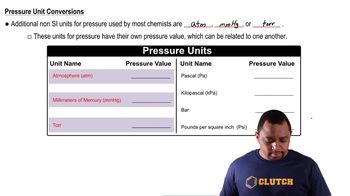
Atmosphere
Non-SI unit frequently used by chemists, equivalent to 760 millimeters of mercury, often memorized for exams.
Millimeters of Mercury
Traditional pressure unit based on the height of a mercury column, numerically equal to torr, commonly abbreviated as mmHg.
Torr
Pressure unit identical in value to millimeters of mercury, widely used in laboratory settings.
Kilopascal
Multiple of the Pascal, equal to 1,000 Pascals, often used for practical pressure measurements.
Bar
Metric unit of pressure, slightly less than one atmosphere, commonly used in meteorology and engineering.
Pounds per Square Inch
Imperial unit for pressure, abbreviated as psi, frequently used in the United States for tire and atmospheric pressure.
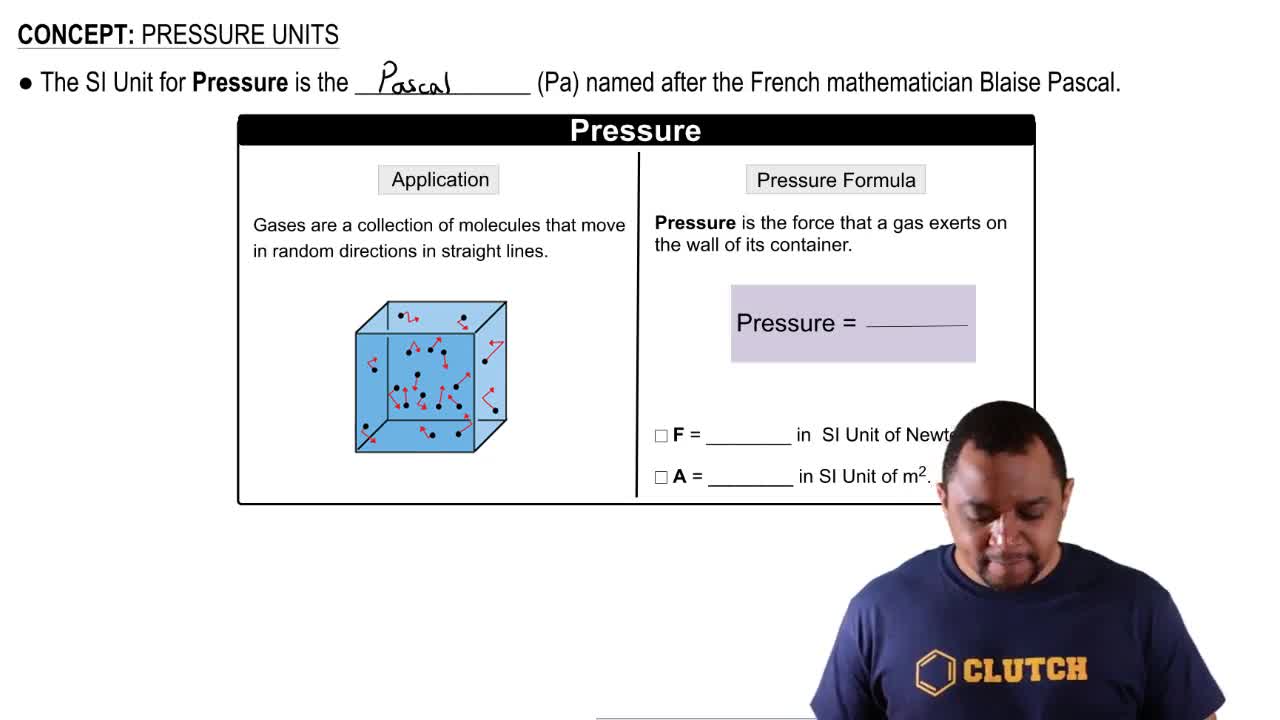
Force
Physical quantity measured in newtons, representing the push or pull exerted by gas molecules on container walls.
Area
Surface measurement in square meters over which force is distributed to calculate pressure.
Newton
SI unit for measuring force, essential for calculating pressure in scientific contexts.
Square Meter
SI unit for measuring area, used as the denominator in the pressure formula.
Conversion Value
Numerical relationship allowing transformation between different pressure units, crucial for solving exam problems.
SI Unit
Internationally accepted measurement standard, ensuring consistency in scientific calculations.
Non-SI Unit
Measurement standard not part of the International System, but still widely used in chemistry and engineering.
Ideal Gas
Theoretical model where gas molecules move randomly and exert pressure by colliding with container walls.
 BackBack
 01:15
01:15