Skip to main content
GOB Chemistry
My Course
Learn
Exam Prep
AI Tutor
Study Guides
Textbook Solutions
Flashcards
Explore
Try the app
My Course
Learn
Exam Prep
AI Tutor
Study Guides
Textbook Solutions
Flashcards
Explore
Try the app
Back
Pyruvate Oxidation definitions
You can tap to flip the card.
Glycolysis
You can tap to flip the card.
👆
Glycolysis
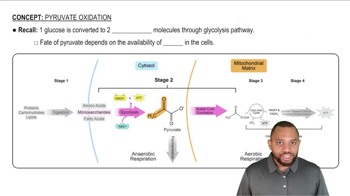
A linear pathway in the cytosol that splits glucose into two pyruvate molecules, producing ATP and NADH.
Track progress
Control buttons has been changed to "navigation" mode.
1/15
Related flashcards
Related practice
Recommended videos
Pyruvate Oxidation quiz
Pyruvate Oxidation
15 Terms
Pyruvate Oxidation
22. Carbohydrate Metabolism
3 problems
Topic
Nicole
Anaerobic Respiration
22. Carbohydrate Metabolism
7 problems
Topic
Nicole
22. Carbohydrate Metabolism
9 topics
15 problems
Chapter
Nicole
Guided course
1:15
Pyruvate Oxidation Example 1
52
views
2
rank
Guided course
1:49
Pyruvate Oxidation Concept 1
2069
views
1
rank
Guided course
1:38
Pyruvate Oxidation Concept 2
1918
views
1
rank
Terms in this set (15)
Hide definitions
Glycolysis
A linear pathway in the cytosol that splits glucose into two pyruvate molecules, producing ATP and NADH.
Pyruvate
A three-carbon molecule produced from glucose breakdown, serving as a metabolic branch point depending on oxygen.
Aerobic Respiration
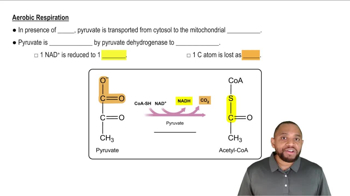
A process requiring oxygen where pyruvate is further oxidized in mitochondria, leading to ATP production.
Fermentation
An anaerobic pathway where pyruvate is metabolized without oxygen, bypassing mitochondrial oxidation.
Acetyl CoA
A two-carbon molecule formed from pyruvate, entering the Krebs cycle for further energy extraction.
Mitochondrial Matrix
The innermost compartment of mitochondria where pyruvate oxidation and the Krebs cycle occur.
Pyruvate Dehydrogenase
An enzyme complex catalyzing the conversion of pyruvate to Acetyl CoA, linking glycolysis to the Krebs cycle.
NAD+
An electron carrier molecule reduced to NADH during pyruvate oxidation, facilitating energy transfer.
NADH
A high-energy electron carrier generated during pyruvate oxidation, later used in ATP synthesis.
Carbon Dioxide
A gaseous byproduct released when a carbon atom is removed from pyruvate during its oxidation.
Coenzyme A
A molecule with a thiol group that binds to the acetyl group, forming Acetyl CoA during pyruvate oxidation.
Krebs Cycle
A mitochondrial pathway following Acetyl CoA formation, central to aerobic energy extraction.
Cytosol
The fluid portion of the cell where glycolysis and initial pyruvate formation take place.
Dehydrogenase
A class of enzymes responsible for oxidation-reduction reactions, especially in energy metabolism.
Common Metabolic Pathway
A sequence of reactions shared by various nutrients, converging at Acetyl CoA formation under aerobic conditions.
 BackBack
 1:15
1:15