Skip to main content
GOB Chemistry
My Course
Learn
Exam Prep
AI Tutor
Study Guides
Textbook Solutions
Flashcards
Explore
Try the app
My Course
Learn
Exam Prep
AI Tutor
Study Guides
Textbook Solutions
Flashcards
Explore
Try the app
Back
Radioactive Half-Life quiz
You can tap to flip the card.
What is the definition of half-life in radioisotopes?
You can tap to flip the card.
👆
What is the definition of half-life in radioisotopes?
Half-life is the time required for half (50%) of a radioisotope to decay.
Track progress
Control buttons has been changed to "navigation" mode.
1/15
Related flashcards
Related practice
Recommended videos
Radioactive Half-Life definitions
Radioactive Half-Life
13 Terms
Radioactive Half-Life
11. Nuclear Chemistry
5 problems
Topic
Jules
Measuring Radioactivity
11. Nuclear Chemistry
7 problems
Topic
Jules
11. Nuclear Chemistry - Part 1 of 2
4 topics
9 problems
Chapter
Jules
11. Nuclear Chemistry - Part 2 of 2
4 topics
9 problems
Chapter
Jules
Guided course
01:06
Radioactive Half-Life Example 1
3914
views
9
rank
Guided course
01:28
Radioactive Half-Life Concept 2
4077
views
5
rank
Guided course
02:09
Radioactive Half-Life Concept 1
4200
views
16
rank
Terms in this set (15)
Hide definitions
What is the definition of half-life in radioisotopes?
Half-life is the time required for half (50%) of a radioisotope to decay.
What does the variable t½ represent in half-life calculations?
t½ represents the half-life, or the time it takes for half of a radioisotope to decay.
How does the decay rate of a radioisotope vary?
The decay rate varies depending on the element and its specific half-life.
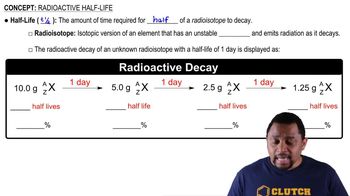
If you start with 10 grams of a radioisotope with a one-day half-life, how much remains after one day?
After one day, 5 grams remain, which is half of the original amount.
How much of the original radioisotope remains after two half-lives?
After two half-lives, 25% of the original amount remains.
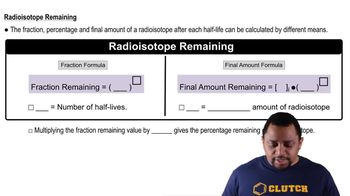
What is the formula for the fraction of radioisotope remaining after n half-lives?
The fraction remaining is calculated as 0.5^n, where n is the number of half-lives.
How do you calculate the percentage of radioisotope remaining after n half-lives?
Multiply the fraction remaining (0.5^n) by 100% to get the percentage.
What is a radioisotope?
A radioisotope is an isotopic version of an element with an unstable nucleus that emits radiation as it decays.
How much of a radioisotope remains after three half-lives if you start with 10 grams?
After three half-lives, 1.25 grams remain, which is 12.5% of the original amount.
What happens to the amount of radioisotope after each half-life?
The remaining amount is reduced by half after each half-life.
How do you calculate the final amount of radioisotope remaining?
Multiply the initial amount by the fraction remaining (0.5^n).
If you start with 100 grams of a radioisotope, how much remains after two half-lives?
After two half-lives, 25 grams remain (100 x 0.5^2 = 25).
What does the symbol 'n' represent in the half-life formulas?
n represents the number of half-lives that have passed.
How can you use the half-life formula for any initial quantity?
You can multiply any initial amount by 0.5^n to find the remaining amount after n half-lives.
What is the relationship between the mass number, atomic number, and isotope symbol?
The isotope symbol is written as X (element), with A as the mass number and Z as the atomic number.
 BackBack
 01:06
01:06