Skip to main content
GOB Chemistry
My Course
Learn
Exam Prep
AI Tutor
Study Guides
Textbook Solutions
Flashcards
Explore
Try the app
My Course
Learn
Exam Prep
AI Tutor
Study Guides
Textbook Solutions
Flashcards
Explore
Try the app
Back
Secondary Protein Structure quiz
You can tap to flip the card.
What type of bonding is responsible for secondary protein structure?
You can tap to flip the card.
👆
What type of bonding is responsible for secondary protein structure?
Hydrogen bonding between the amide hydrogen and carbonyl oxygen in the protein backbone is responsible for secondary structure.
Track progress
Control buttons has been changed to "navigation" mode.
1/15
Related flashcards
Related practice
Recommended videos
Secondary Protein Structure definitions
Secondary Protein Structure
15 Terms
Secondary Protein Structure
18. Amino Acids and Proteins
7 problems
Topic
Jules
Tertiary Protein Structure
18. Amino Acids and Proteins
7 problems
Topic
Jules
18. Amino Acids and Proteins - Part 1 of 2
6 topics
13 problems
Chapter
Jules
18. Amino Acids and Proteins - Part 2 of 2
5 topics
13 problems
Chapter
Jules
Guided course
1:09
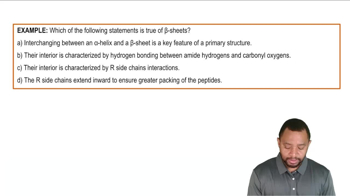
Secondary Protein Structure Example 4
2165
views
2
rank
Guided course
2:00
Secondary Protein Structure Example 1
2289
views
2
rank
Guided course
0:56
Secondary Protein Structure Example 3
2135
views
3
rank
Terms in this set (15)
Hide definitions
What type of bonding is responsible for secondary protein structure?
Hydrogen bonding between the amide hydrogen and carbonyl oxygen in the protein backbone is responsible for secondary structure.
What are the two main types of secondary protein structures?
The two main types are the alpha helix and the beta pleated sheet.
In an alpha helix, how are the hydrogen bonds formed?
Hydrogen bonds form between distant amino acids on the same polypeptide chain.
What is the shape of an alpha helix?
An alpha helix is a right-handed or clockwise spiral staircase.
Where are the R groups located in an alpha helix?
The R groups are positioned outside the helix due to spacing requirements.
How many amino acid residues are there per turn in an alpha helix?
There are an average of 3.6 residues per turn in an alpha helix.
What is the main stabilizing force in both alpha helices and beta sheets?
Hydrogen bonding is the main stabilizing force in both structures.
How are beta pleated sheets formed?
Beta pleated sheets are formed by two or more beta strands oriented side by side, connected by hydrogen bonds.
What gives beta sheets their 'pleated' appearance?
The zigzag pattern of the peptide chains gives beta sheets their pleated appearance.
Where are the R groups located in a beta pleated sheet?
R groups are oriented above and below the sheet to optimize spacing.
What is the difference in hydrogen bonding between alpha helices and beta sheets?
In alpha helices, hydrogen bonds are within the same chain, while in beta sheets, they are between different chains or segments.
What is depicted by dashed lines in diagrams of secondary protein structure?
Dashed lines represent hydrogen bonds, which are intermolecular forces, not actual bonds.
What is the relationship between primary and secondary protein structure?
The primary structure (sequence of amino acids) folds into secondary structures like alpha helices and beta sheets.
Why can't R groups be inside the alpha helix or beta sheet?
Due to spatial constraints and hydrogen bonding in the interior, R groups are positioned outside or above/below the structure.
What is the role of hydrogen bonding in secondary protein structure?
Hydrogen bonding helps stabilize the repeating patterns of alpha helices and beta sheets in proteins.
 BackBack
 1:09
1:09