Back

Skeletal Formula quiz

Control buttons has been changed to "navigation" mode.
1/15
  • What is another name for a skeletal formula in organic chemistry?

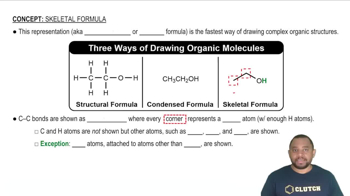
    Skeletal formula is also known as a bond line or line formula.
  • How are carbon-carbon bonds represented in a skeletal formula?

    Carbon-carbon bonds are shown as lines in a skeletal formula.
  • In a skeletal formula, what does each corner or end of a line represent?

    Each corner or end of a line represents a carbon atom.
  • Are carbon atoms explicitly shown in skeletal formulas?

    No, carbon atoms are implied at the corners and ends of lines.
  • How are hydrogen atoms bonded to carbon represented in skeletal formulas?

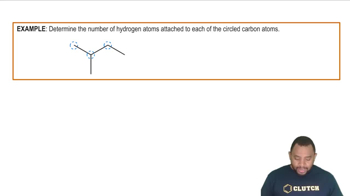
    Hydrogen atoms bonded to carbon are not shown; they are assumed to be present to complete four bonds for each carbon.
  • When are hydrogen atoms shown in skeletal formulas?

    Hydrogen atoms are shown when they are attached to atoms other than carbon, such as oxygen.
  • Which atoms are explicitly shown in skeletal formulas?

    Atoms such as oxygen, nitrogen, and sulfur are explicitly shown.
  • Why are skeletal formulas preferred over structural and condensed formulas for complex molecules?

    Skeletal formulas are faster and more efficient for drawing complex organic structures.
  • How many bonds must each carbon atom have in a skeletal formula?

    Each carbon atom must have four bonds in total.
  • What does a line between two corners in a skeletal formula indicate?

    A line between two corners indicates a bond between two carbon atoms.
  • How is an oxygen atom represented in a skeletal formula?

    Oxygen atoms are explicitly shown using the letter 'O' in the skeletal formula.
  • What is the main advantage of using skeletal formulas in organic chemistry?

    The main advantage is the speed and simplicity in representing complex molecules.
  • How does a skeletal formula relate to condensed and structural formulas?

    A skeletal formula is a more efficient way to represent both condensed and structural formulas.
  • What happens to the hydrogens on carbon atoms in a skeletal formula?

    They are not shown but are assumed to be present to satisfy carbon's four-bond rule.
  • Why will students use skeletal formulas more as they advance in organic chemistry?

    Because skeletal formulas allow for quicker and clearer representation of increasingly complex organic compounds.