Back

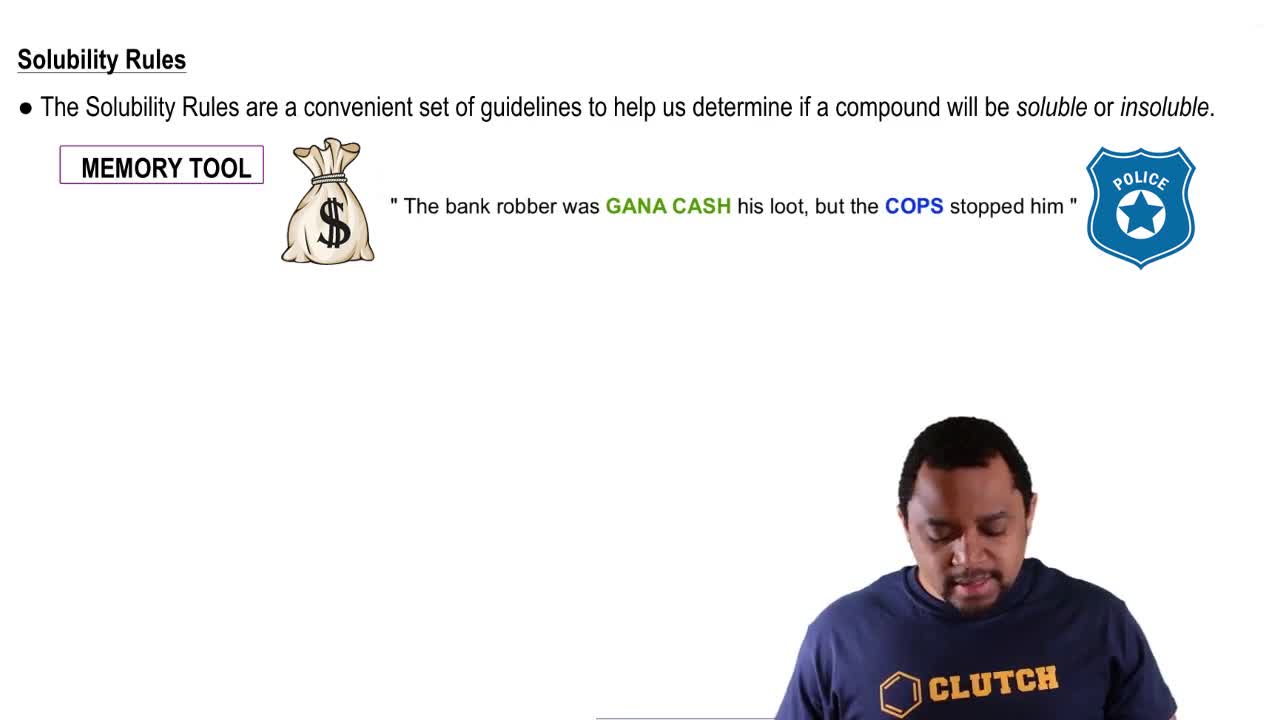
Solubility Rules definitions

Control buttons has been changed to "navigation" mode.
1/17
  • Solubility

    Chemical property describing how a solute can dissolve in a solvent to form a solution, often resulting in ions in aqueous solutions.
  • Solute

    Substance that is dissolved in a solvent, forming part of a solution and potentially breaking into ions if soluble.
  • Solvent

    Medium in which a solute dissolves, commonly water in solubility discussions, enabling the formation of solutions.
  • Aqueous Ion

    Charged particle surrounded by water molecules in solution, resulting from the dissolution of a soluble ionic compound.
  • Precipitate

    Solid formed when an insoluble compound results from mixing ions in solution, indicating an exception to solubility.
  • Group 1A Elements

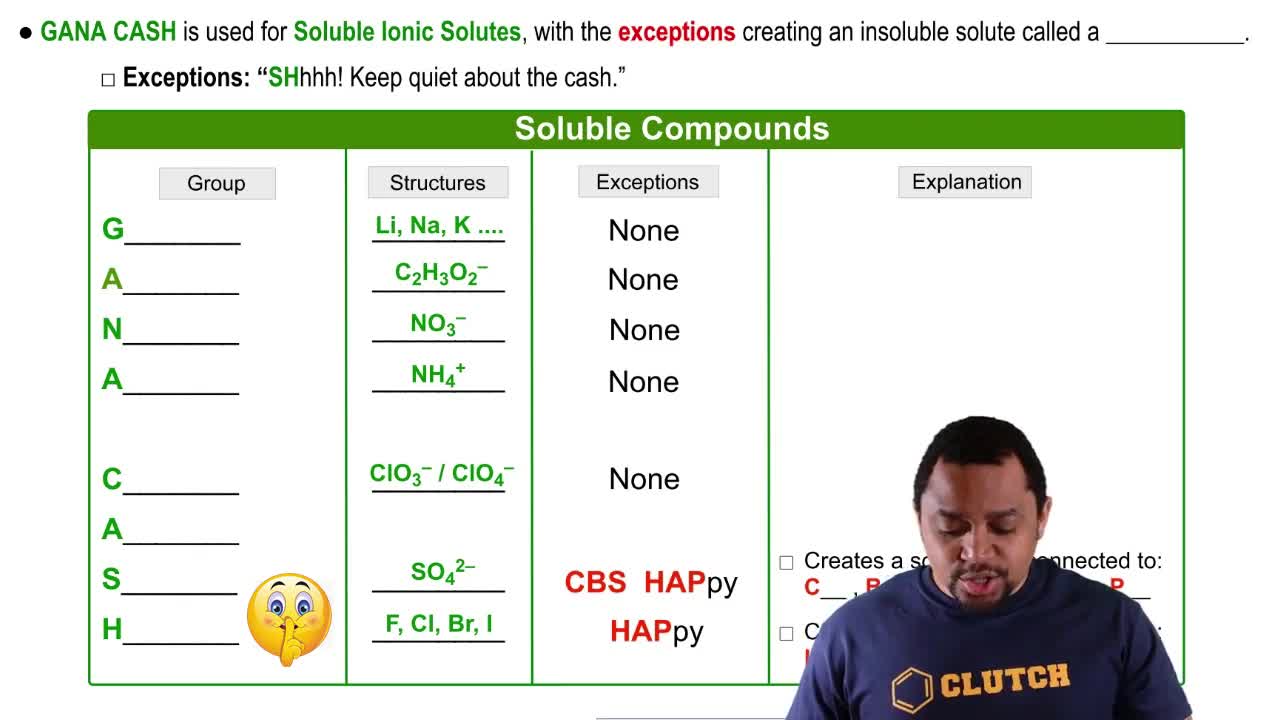
    Alkali metals such as lithium, sodium, and potassium, whose compounds are always soluble with no exceptions.
  • Acetate

    Ion with the formula CH3COO−, always forms soluble compounds in aqueous solutions.
  • Nitrate

    Ion with the formula NO3−, universally produces soluble compounds in water.
  • Ammonium

    Ion with the formula NH4+, consistently yields soluble compounds in aqueous environments.
  • Chlorate

    Ion with the formula ClO3−, always associated with soluble compounds, including its relative perchlorate.
  • Sulfate

    Ion with the formula SO4^2−, generally soluble except when combined with certain metals like calcium, barium, or lead.
  • Halogens

    Group 7A elements such as chlorine, bromine, and iodine, usually forming soluble compounds except with mercury, silver, or lead.
  • Carbonate

    Ion with the formula CO3^2−, typically forms insoluble compounds unless exceptions apply.
  • Oxide

    Ion with the formula O^2−, generally insoluble but becomes soluble with calcium, barium, or strontium.
  • Phosphate

    Ion with the formula PO4^3−, usually results in insoluble compounds in water.
  • Hydroxide

    Ion with the formula OH−, mostly insoluble except when paired with calcium, barium, or strontium.
  • Sulfide

    Ion with the formula S^2−, forms insoluble compounds except with calcium, barium, or strontium.