Back

Subatomic Particles (Simplified) definitions

Control buttons has been changed to "navigation" mode.
1/12
  • Atom

    Smallest unit of matter, composed of a nucleus and surrounding electrons, forming the basis of chemical elements.
  • Nucleus

    Dense central region of an atom, containing protons and neutrons, accounting for most of the atom's mass.
  • Neutron

    Subatomic particle found in the nucleus, electrically neutral, and slightly heavier than a proton.
  • Proton

    Positively charged subatomic particle located in the nucleus, nearly equal in mass to a neutron.
  • Electron

    Negatively charged subatomic particle, extremely light compared to protons and neutrons, found outside the nucleus.
  • Atomic Mass Unit

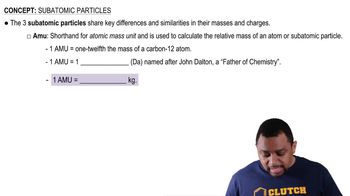
    Standard unit for measuring atomic and subatomic masses, defined as 1/12 the mass of a carbon atom.
  • Dalton

    Alternative name for the atomic mass unit, commonly abbreviated as DA, honoring a pioneer in chemistry.
  • Relative Mass

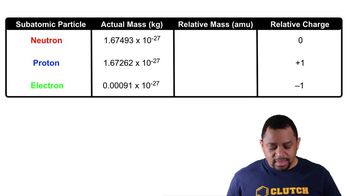
    Comparison of a particle's mass to the atomic mass unit, allowing easy evaluation of subatomic particle sizes.
  • Actual Mass

    Precise mass of a particle measured in kilograms, used for scientific calculations and conversions.
  • Relative Charge

    Comparison of a particle's electric charge to a standard, with values of +1, -1, or 0 for subatomic particles.
  • Conversion Factor

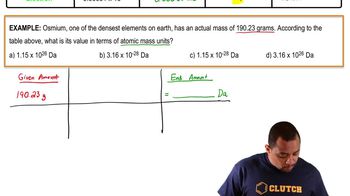
    Numerical value used to switch between atomic mass units and kilograms, essential for mass calculations.
  • Carbon Atom

    Reference element for defining the atomic mass unit, specifically using one-twelfth of its mass.