GOB Chemistry
My Course
Learn
Exam Prep
AI Tutor
Study Guides
Textbook Solutions
Flashcards
Explore
My Course
Learn
Exam Prep
AI Tutor
Study Guides
Textbook Solutions
Flashcards
Explore
Back
Tertiary Protein Structure definitions
You can tap to flip the card.
Define:
Tertiary Structure
You can tap to
flip the card.
👆
Tertiary Structure
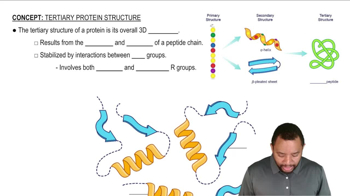
Overall three-dimensional folding of a peptide chain, stabilized by interactions among R groups, bringing the protein closer to full functionality.
Track progress
Control buttons has been changed to "navigation" mode.
1/14
Related practice
Recommended videos
Guided course
2:07
Tertiary Protein Structure Concept 1
Jules
1013
views
1
rank
Guided course
1:17
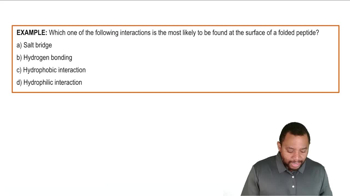
Tertiary Protein Structure Example 1
Jules
933
views
Guided course
2:41
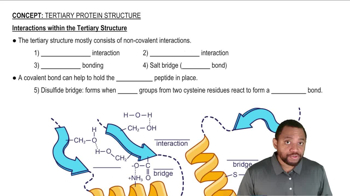
Interactions within the Tertiary Structure Concept 2
Jules
1016
views
Terms in this set (14)
Hide definitions
Tertiary Structure
Overall three-dimensional folding of a peptide chain, stabilized by interactions among R groups, bringing the protein closer to full functionality.
Peptide Chain
Linear sequence of amino acids linked by peptide bonds, serving as the backbone for higher-level protein folding.
R Group
Variable side chain of an amino acid, responsible for unique chemical properties and interactions within proteins.
Alpha Helix
Coiled secondary structure element within proteins, often incorporated into the overall folded shape.
Beta Pleated Sheet
Sheet-like secondary structure formed by hydrogen bonding between backbone atoms, contributing to protein folding.
Hydrophobic Interaction
Attraction between nonpolar side chains, causing them to cluster away from water and stabilize protein folding.
Hydrophilic Interaction
Association of polar side chains with water, promoting exposure of these groups on the protein surface.
Hydrogen Bonding
Attraction between polar groups, such as those containing OH, contributing to the stability of the folded protein.
Salt Bridge
Ionic bond formed between oppositely charged side chains, enhancing the stability of the protein's three-dimensional shape.
Disulfide Bridge
Covalent bond between sulfur atoms of two cysteine residues, strongly linking different regions of the protein.
Cysteine Residue
Amino acid unit containing a thiol group, capable of forming strong covalent links in protein structures.
Primary Structure
Linear order of amino acids in a protein, serving as the foundation for all higher levels of structure.
Secondary Structure
Localized folding patterns, such as coils and sheets, arising from backbone interactions in a protein.
Polypeptide
Long chain of amino acids, which can fold into complex structures to form functional proteins.