Back

The Electron Configuration: Exceptions (Simplified) quiz

Control buttons has been changed to "navigation" mode.
1/15
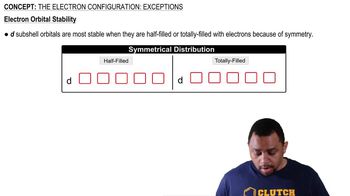
  • What is the most stable arrangement for d subshell orbitals according to Hund's rule?

    d subshell orbitals are most stable when they are either half-filled or fully filled due to symmetry.
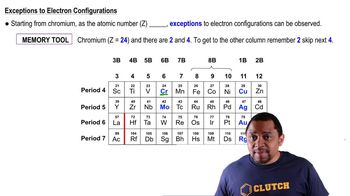
  • What atomic number does chromium have, and why is it significant for electron configuration exceptions?

    Chromium has atomic number 24, marking the start of notable exceptions in electron configurations.
  • Which elements are skipped after chromium before reaching the next major exception in electron configuration?

    Manganese, iron, cobalt, and nickel are skipped before reaching copper.
  • What is the expected electron configuration for chromium before considering exceptions?

    The expected configuration is [Ar] 4s2 3d4.
  • How does chromium's actual electron configuration differ from the expected one?

    Chromium's actual configuration is [Ar] 4s1 3d5, with one electron promoted from the s to the d orbital.
  • Why does chromium promote an electron from the 4s to the 3d orbital?

    It promotes an electron to achieve a half-filled d5 state, which is more stable.
  • What is the expected electron configuration for copper before considering exceptions?

    The expected configuration is [Ar] 4s2 3d9.
  • How does copper's actual electron configuration differ from the expected one?

    Copper's actual configuration is [Ar] 4s1 3d10, with one electron promoted to fill the d orbital.
  • What is the driving force behind the electron configuration exceptions in chromium and copper?

    The drive is to achieve either half-filled or fully filled d subshells for enhanced stability.
  • What happens to the 4s electrons in chromium and copper during these exceptions?

    One 4s electron is promoted to the 3d orbital in both cases.
  • How many electrons are in the d subshell of chromium after the exception is applied?

    There are 5 electrons in the d subshell (d5) after the exception.
  • How many electrons are in the d subshell of copper after the exception is applied?

    There are 10 electrons in the d subshell (d10) after the exception.
  • What memory tool can help you remember where electron configuration exceptions start?

    Remember that exceptions start at chromium (atomic number 24) and then skip four columns to copper.
  • What rule explains why electrons fill degenerate orbitals singly before pairing up?

    Hund's rule explains that electrons fill degenerate orbitals singly to maximize symmetry and stability.
  • Why are half-filled and fully filled d subshells particularly stable?

    They are stable due to increased symmetry and exchange energy, making the atom more stable overall.