 Back
BackTotal Energy from Glucose definitions

 2:48
2:48
Terms in this set (15)
Glycolysis
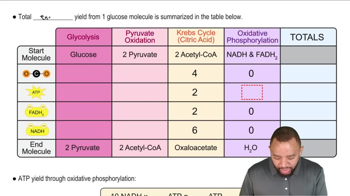
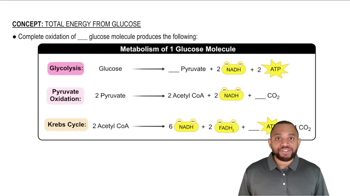
A metabolic pathway of 10 reactions splitting glucose into two pyruvate molecules, yielding 2 ATP and 2 NADH, with no CO2 or FADH2 produced.
Pyruvate Oxidation
A process converting two pyruvate molecules into two Acetyl CoA, generating 2 NADH and 2 CO2, without producing ATP or FADH2.
Krebs Cycle
A mitochondrial matrix pathway processing Acetyl CoA, producing 6 NADH, 2 FADH2, 2 ATP, and 4 CO2 per glucose molecule.
Citric Acid Cycle
Another name for the Krebs Cycle, emphasizing the cyclical series of reactions generating high-energy molecules from Acetyl CoA.
Oxidative Phosphorylation
A stage combining the Electron Transport Chain and ATP synthesis, using NADH and FADH2 to generate the majority of ATP.
Electron Transport Chain
A mitochondrial inner membrane system transferring electrons from NADH and FADH2 to oxygen, driving ATP production.
Acetyl CoA
A two-carbon molecule entering the Krebs Cycle, formed from pyruvate oxidation, serving as a key metabolic intermediate.
NADH
A high-energy electron carrier produced during glycolysis, pyruvate oxidation, and the Krebs Cycle, crucial for ATP generation.
FADH2
An electron carrier generated in the Krebs Cycle, contributing electrons to the Electron Transport Chain for ATP synthesis.
ATP
The main energy currency of the cell, produced in glycolysis, the Krebs Cycle, and mainly through oxidative phosphorylation.
CO2
A waste product released during pyruvate oxidation and the Krebs Cycle, representing the complete oxidation of glucose carbon atoms.
Mitochondrial Matrix
The compartment within mitochondria where the Krebs Cycle and pyruvate oxidation occur, facilitating energy extraction from nutrients.
Cytosol
The fluid portion of the cell where glycolysis takes place, initiating glucose breakdown before mitochondrial processes.
Oxaloacetate
A four-carbon molecule regenerated at the end of the Krebs Cycle, enabling the cycle to continue processing Acetyl CoA.
Catabolism
The overall process of breaking down complex molecules like glucose into simpler ones, releasing energy for cellular activities.