Skip to main content
GOB Chemistry
My Course
Learn
Exam Prep
AI Tutor
Study Guides
Textbook Solutions
Flashcards
Explore
Try the app
My Course
Learn
Exam Prep
AI Tutor
Study Guides
Textbook Solutions
Flashcards
Explore
Try the app
Back
Intro to Radioactivity definitions
You can tap to flip the card.
Nuclear Reaction
You can tap to flip the card.
👆
Nuclear Reaction
A process involving changes in unstable atomic nuclei, often resulting in the transformation of one element into another.
Track progress
Control buttons has been changed to "navigation" mode.
1/15
Related flashcards
Related practice
Recommended videos
Intro to Radioactivity quiz
Intro to Radioactivity
15 Terms
Types of Radiation
11. Nuclear Chemistry
7 problems
Topic
Jules
Alpha Decay
11. Nuclear Chemistry
3 problems
Topic
Jules
11. Nuclear Chemistry - Part 1 of 2
4 topics
9 problems
Chapter
Jules
11. Nuclear Chemistry - Part 2 of 2
4 topics
9 problems
Chapter
Jules
Guided course
01:08
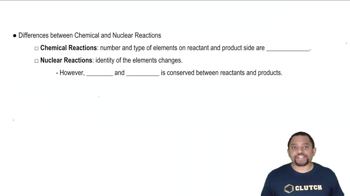
Nuclear vs Chemical Reactions
4165
views
37
rank
Guided course
02:29
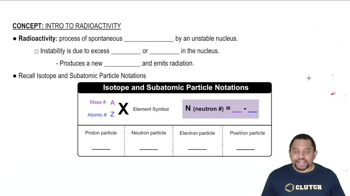
Intro to Radioactivity
4657
views
29
rank
1
comments
Guided course
00:45
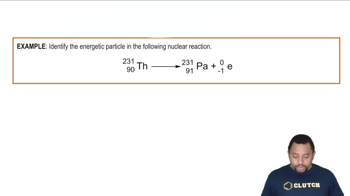
Nuclear Reaction Example
171
views
5
rank
Terms in this set (15)
Hide definitions
Nuclear Reaction
A process involving changes in unstable atomic nuclei, often resulting in the transformation of one element into another.
Unstable Nucleus
A central region of an atom with an imbalance of protons and neutrons, leading to spontaneous radioactive changes.
Proton
A positively charged subatomic particle found in the nucleus, determining the identity of an element.
Neutron
A neutral subatomic particle located in the nucleus, contributing to atomic mass but not charge.
Radioactive Element
A type of atom with a nucleus that spontaneously emits particles or energy due to instability.
Alpha Decay
A nuclear process where an energetic particle is released, resulting in a new element with a lower atomic number.
Beta Decay
A transformation in which a high-energy particle is emitted, altering the atomic number and producing a new element.
Gamma Emission
A release of high-energy electromagnetic radiation from an excited nucleus, usually without changing atomic number.
Positron Emission
A type of radioactivity where a particle with the same mass as an electron but opposite charge is released.
Electron Capture
A process where an inner orbital particle is absorbed by the nucleus, leading to a change in atomic number.
Parent Nuclide
An original unstable isotope that undergoes transformation during a nuclear process, appearing as a reactant.
Daughter Nuclide
A more stable isotope formed as a product after a nuclear transformation of a parent.
Energetic Particle
A subatomic entity released or absorbed during nuclear changes, responsible for altering atomic structure.
Radioisotope
An atom with an unstable nucleus that emits radiation as it transforms into a more stable form.
Rutherfordium
A synthetic element named to honor a pioneer in nuclear chemistry, symbolizing major contributions to the field.
 BackBack
 01:08
01:08