GOB Chemistry
My Course
Learn
Exam Prep
AI Tutor
Study Guides
Textbook Solutions
Flashcards
Explore
Try the app
My Course
Learn
Exam Prep
AI Tutor
Study Guides
Textbook Solutions
Flashcards
Explore
Try the app
Back
Writing Formula Units of Ionic Compounds definitions
You can tap to flip the card.
Formula Unit
You can tap to flip the card.
👆
Formula Unit
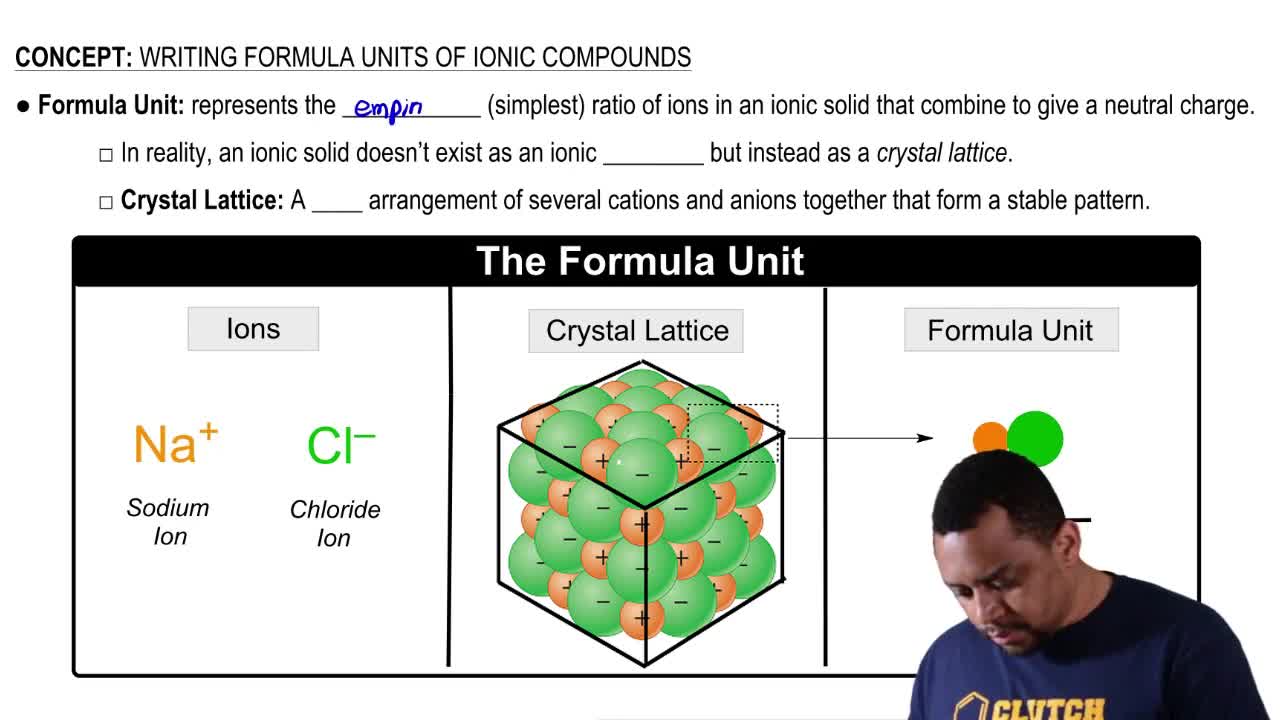
Simplest ratio of ions in an ionic solid that results in a neutral charge, representing the empirical composition of the compound.
Track progress
Control buttons has been changed to "navigation" mode.
1/14
Related flashcards
Related practice
Recommended videos
Writing Formula Units of Ionic Compounds quiz
Writing Formula Units of Ionic Compounds
15 Terms
Writing Formula Units of Ionic Compounds
3. Ionic Compounds
6 problems
Topic

Jules
Naming Ionic Hydrates
3. Ionic Compounds
1 problem
Topic
Jules
3. Ionic Compounds - Part 1 of 2
5 topics
9 problems
Chapter
Jules
3. Ionic Compounds - Part 2 of 2
6 topics
9 problems
Chapter
Jules
Guided course
01:46
Writing Formula Units of Ionic Compounds Concept 1
5045
views
20
rank
Guided course
03:09
Writing Formula Units of Ionic Compounds Concept 2
9669
views
89
rank
Guided course
00:34
Writing Formula Units of Ionic Compounds Example 1
4444
views
17
rank
Terms in this set (14)
Hide definitions
Formula Unit
Simplest ratio of ions in an ionic solid that results in a neutral charge, representing the empirical composition of the compound.
Crystal Lattice
Three-dimensional arrangement of cations and anions in a stable, repeating pattern within an ionic solid.
Cation
Positively charged particle formed when an atom loses electrons, commonly found in ionic compounds.
Anion
Negatively charged particle formed when an atom gains electrons, pairing with cations in ionic compounds.
Empirical Ratio
Smallest whole-number proportion of ions that combine to form a neutral ionic compound.
Polyatomic Ion
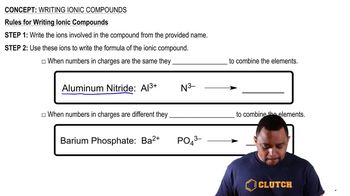
Charged group of covalently bonded atoms acting as a single ion, such as phosphate (PO4)3-.
Crisscross Method
Technique where numerical values of ion charges are swapped to balance overall charge in an ionic formula.
Parentheses
Symbols used around polyatomic ions in formulas when a subscript greater than one is needed to indicate quantity.
Periodic Table Group
Vertical column in the periodic table indicating elements with similar properties and common ionic charges.
Charge Balance
Condition where total positive and negative charges in a compound equal zero, resulting in neutrality.
Ionic Compound
Substance composed of cations and anions held together by electrostatic attraction in a fixed ratio.
Subscript
Small number written below and to the right of a chemical symbol, indicating the quantity of atoms or ions.
Tetraoxide
Polyatomic ion containing four oxygen atoms, as seen in phosphate (PO4)3-.
Neutrality
State achieved when the sum of positive and negative charges in a formula unit is zero.