Back

Writing Formula Units of Ionic Compounds quiz

Control buttons has been changed to "navigation" mode.
1/15
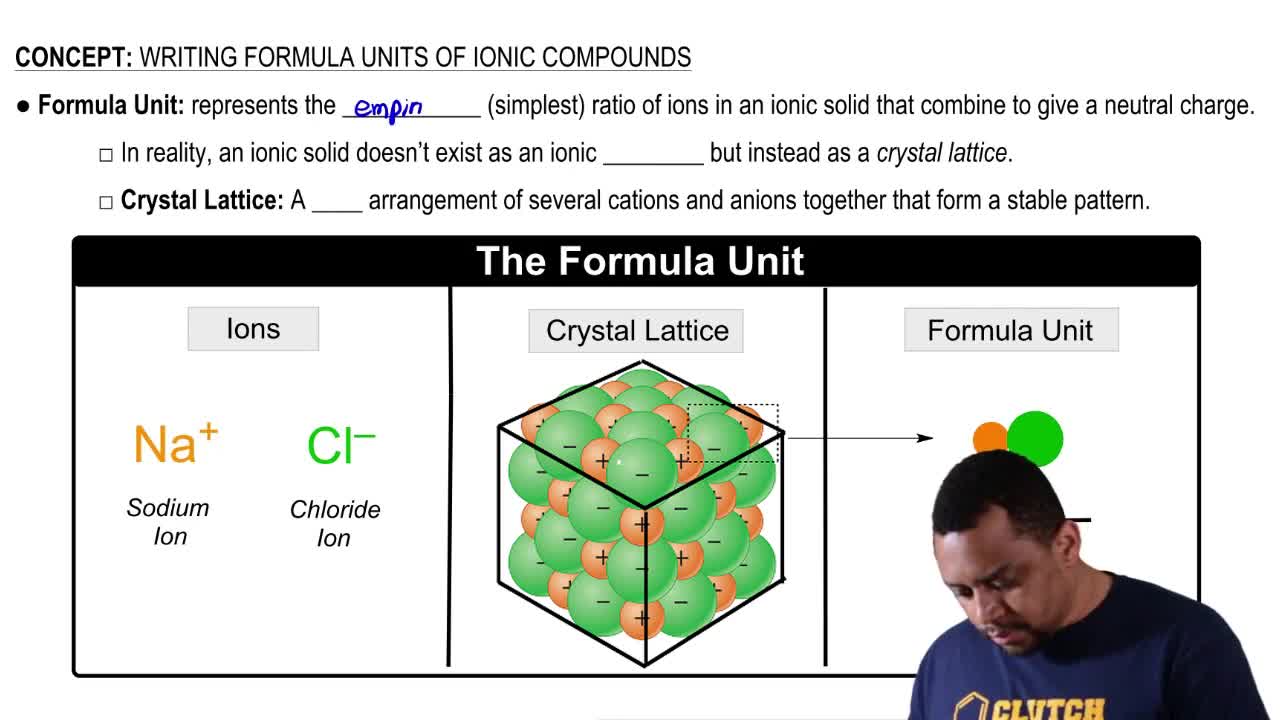
  • What does the formula unit of an ionic compound represent?

    It represents the simplest ratio of ions that combine to give a neutral charge in an ionic solid.
  • What is a crystal lattice in the context of ionic solids?

    A crystal lattice is a 3D arrangement of cations and anions that form a stable pattern in an ionic solid.
  • How do you determine the ions involved in an ionic compound from its name?

    Identify the cation and anion from the compound's name and determine their charges, often based on their group in the periodic table.
  • What is the charge of an aluminum ion and how is it determined?

    Aluminum ion has a charge of 3+ because aluminum is in group 3A of the periodic table.
  • What is the charge of a nitride ion and how is it determined?

    Nitride ion has a charge of 3- because nitrogen is in group 5A of the periodic table.
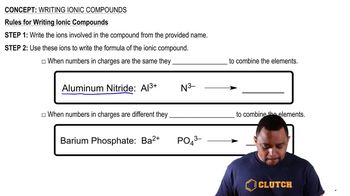
  • What is the formula for aluminum nitride and why?

    The formula is AlN because the charges of Al3+ and N3- cancel each other out in a 1:1 ratio.
  • What is the charge of a barium ion?

    Barium ion has a charge of 2+ because barium is in group 2A of the periodic table.
  • What is the formula and charge of the phosphate ion?

    The phosphate ion is PO4 with a charge of 3-.
  • How do you write the formula for barium phosphate using the crisscross method?

    Write Ba3(PO4)2 by crisscrossing the numerical values of the charges to balance the overall charge.
  • When do you use parentheses in the formula of an ionic compound?

    Use parentheses around a polyatomic ion when its subscript is greater than one.
  • What is the first step in writing the formula of an ionic compound from its name?

    The first step is to write the ions involved in the compound with their respective charges.
  • What do you do if the charges of the ions in an ionic compound are equal and opposite?

    If the charges are equal and opposite, they cancel out, resulting in a 1:1 ratio in the formula.
  • What do you do if the charges of the ions in an ionic compound are different?

    If the charges are different, use the crisscross method to balance the charges and write the formula.
  • What does the crisscross method involve when writing ionic formulas?

    It involves swapping the numerical values of the charges to become the subscripts for the other ion.
  • Why is it important to ignore the signs of the charges when using the crisscross method?

    Because only the numbers are used to balance the formula, and the charges will automatically be neutralized.