Pearson+ LogoPearson+ Logo
Ch.6 Carbohydrates Life's Sweet Molecules
Frost - General, Organic and Biological Chemistry 4th Edition
Frost4th EditionGeneral, Organic and Biological ChemistryISBN: 9780134988696Not the one you use?Change textbook
Chapter 3, Problem 10a

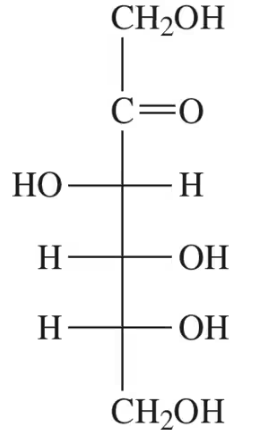
Classify each of the following monosaccharides by the type of carbonyl group and the number of carbons (for example, a monosaccharide with an aldehyde and three carbons is an aldotriose).
(a) Structural representation of a monosaccharide with a carbonyl group and multiple hydroxyl groups.

Verified step by step guidance
1
Step 1: Identify the type of carbonyl group present in the monosaccharide. Monosaccharides can have either an aldehyde group (making them aldoses) or a ketone group (making them ketoses). Look at the structure provided in the image to determine if the carbonyl group is at the end of the chain (aldehyde) or within the chain (ketone).
Step 2: Count the number of carbon atoms in the monosaccharide. Monosaccharides are classified based on the number of carbons in their structure, such as triose (3 carbons), tetrose (4 carbons), pentose (5 carbons), or hexose (6 carbons). Carefully examine the image and count the total number of carbon atoms.
Step 3: Combine the information from Steps 1 and 2 to classify the monosaccharide. For example, if the monosaccharide has an aldehyde group and three carbons, it is classified as an aldotriose. Similarly, if it has a ketone group and six carbons, it is classified as a ketohexose.
Step 4: Verify your classification by ensuring that the functional group and carbon count match the naming convention. Double-check the structure in the image to confirm your observations.
Step 5: Write down the final classification of the monosaccharide based on the type of carbonyl group and the number of carbons. This will be the name of the monosaccharide, such as aldotriose, ketotetrose, etc.

Verified video answer for a similar problem:

This video solution was recommended by our tutors as helpful for the problem above.
Video duration:
2m
Was this helpful?

Key Concepts

Here are the essential concepts you must grasp in order to answer the question correctly.

Monosaccharides

Monosaccharides are the simplest form of carbohydrates, consisting of single sugar molecules. They can be classified based on the number of carbon atoms they contain and the type of carbonyl group present, which can either be an aldehyde or a ketone. Common examples include glucose and fructose, which are essential for energy production in living organisms.
Recommended video:
Guided course
0:55
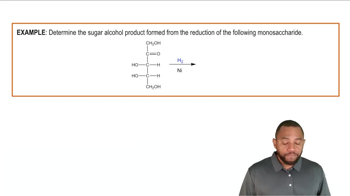
Reduction of Monosaccharides Example 1

Carbonyl Group

The carbonyl group is a functional group characterized by a carbon atom double-bonded to an oxygen atom (C=O). In monosaccharides, the position of the carbonyl group determines whether the sugar is classified as an aldose (with an aldehyde group at the end of the carbon chain) or a ketose (with a ketone group within the carbon chain). This classification is crucial for understanding the structure and reactivity of sugars.
Recommended video:
Guided course
1:00
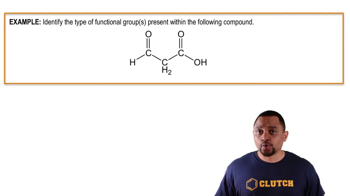
Functional Groups with Carbonyls Example 3

Classification of Monosaccharides

Monosaccharides can be classified based on two criteria: the type of carbonyl group and the number of carbon atoms. For instance, an aldose with three carbons is termed an aldotriose, while a ketose with four carbons is called a ketotetrose. This systematic classification helps in identifying and categorizing different sugars, which is important in biochemistry and nutrition.
Recommended video:
Guided course
0:55
Reduction of Monosaccharides Example 1