Pearson+ LogoPearson+ Logo
Ch.6 Carbohydrates Life's Sweet Molecules
Frost - General, Organic and Biological Chemistry 4th Edition
Frost4th EditionGeneral, Organic and Biological ChemistryISBN: 9780134988696Not the one you use?Change textbook
Chapter 3, Problem 1a

Classify the following carbohydrates as a monosaccharide, disaccharide, oligosaccharide, or polysaccharide:
(a) carageenan, a seaweed extract containing up to 25,000 carbohydrate units

Verified step by step guidance
1
Understand the classification of carbohydrates: Carbohydrates are classified based on the number of sugar units they contain. Monosaccharides have one sugar unit, disaccharides have two, oligosaccharides have 3-10, and polysaccharides have more than 10 sugar units.
Analyze the given carbohydrate: Carageenan is described as a seaweed extract containing up to 25,000 carbohydrate units.
Compare the number of carbohydrate units in carageenan to the classification criteria: Since carageenan contains significantly more than 10 sugar units, it falls into the category of polysaccharides.
Recall the definition of polysaccharides: Polysaccharides are large molecules composed of many monosaccharide units linked together, often used for structural or storage purposes in organisms.
Conclude the classification: Based on the information provided, carageenan is classified as a polysaccharide.

Verified video answer for a similar problem:

This video solution was recommended by our tutors as helpful for the problem above.
Video duration:
1m
Was this helpful?

Key Concepts

Here are the essential concepts you must grasp in order to answer the question correctly.

Monosaccharides

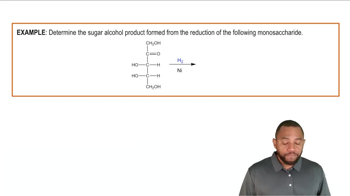
Monosaccharides are the simplest form of carbohydrates, consisting of single sugar molecules such as glucose and fructose. They serve as the building blocks for more complex carbohydrates and are easily absorbed by the body. Their structure typically includes a carbon backbone with hydroxyl groups, making them soluble in water.
Recommended video:
Guided course
0:55
Reduction of Monosaccharides Example 1

Polysaccharides

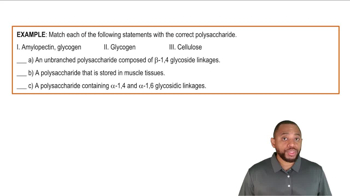
Polysaccharides are large carbohydrate molecules composed of long chains of monosaccharide units linked together by glycosidic bonds. They can consist of hundreds to thousands of sugar units, and examples include starch, glycogen, and cellulose. Polysaccharides serve various functions, including energy storage and providing structural support in plants.
Recommended video:
Guided course
1:24
Polysaccharides Example 1

Carbohydrate Classification

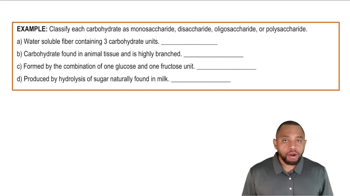
Carbohydrates are classified based on the number of sugar units they contain: monosaccharides (1 unit), disaccharides (2 units), oligosaccharides (3-10 units), and polysaccharides (more than 10 units). This classification helps in understanding their structure, function, and role in biological processes. For instance, carageenan, mentioned in the question, is a polysaccharide due to its extensive chain of carbohydrate units.
Recommended video:
Guided course
1:29
Classification of Carbohydrates Example 1