Pearson+ LogoPearson+ Logo
Ch.6 Carbohydrates Life's Sweet Molecules
Frost - General, Organic and Biological Chemistry 4th Edition
Frost4th EditionGeneral, Organic and Biological ChemistryISBN: 9780134988696Not the one you use?Change textbook
Chapter 3, Problem 19a

Identify the monosaccharide that fits each of the following descriptions:
(a) also referred to as dextrose

Verified step by step guidance
1
Understand the term 'monosaccharide': Monosaccharides are the simplest form of carbohydrates and are single sugar molecules. Examples include glucose, fructose, and galactose.
Recognize the term 'dextrose': Dextrose is a common name for glucose, specifically the D-isomer of glucose, which is the naturally occurring form.
Recall that glucose is a monosaccharide with the molecular formula C₆H₁₂O₆ and is classified as an aldohexose because it contains an aldehyde group and six carbon atoms.
Note that glucose is widely used in biological systems as a primary energy source and is commonly referred to as dextrose in medical and food contexts.
Conclude that the monosaccharide referred to as dextrose is glucose, based on its chemical properties and common usage.

Verified video answer for a similar problem:

This video solution was recommended by our tutors as helpful for the problem above.
Video duration:
1m
Was this helpful?

Key Concepts

Here are the essential concepts you must grasp in order to answer the question correctly.

Monosaccharides

Monosaccharides are the simplest form of carbohydrates, consisting of single sugar molecules. They serve as the building blocks for more complex carbohydrates and are crucial for energy production in living organisms. Common examples include glucose, fructose, and galactose.
Recommended video:
Guided course
0:55
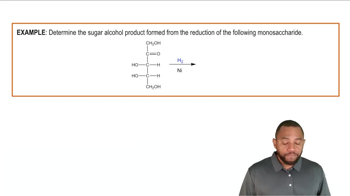
Reduction of Monosaccharides Example 1

Dextrose

Dextrose is a specific type of monosaccharide that is chemically identical to glucose. It is often derived from corn and is commonly used in food products and medical solutions due to its quick absorption and energy-boosting properties. Dextrose is frequently referred to as 'blood sugar' because it is the primary sugar found in the bloodstream.

Chemical Structure of Glucose

The chemical structure of glucose, or dextrose, is characterized by its six carbon atoms, twelve hydrogen atoms, and six oxygen atoms, represented by the formula C6H12O6. This structure allows glucose to exist in both linear and cyclic forms, with the cyclic form being predominant in aqueous solutions. Understanding this structure is essential for recognizing how glucose functions in biological systems.
Recommended video:
Guided course
2:07
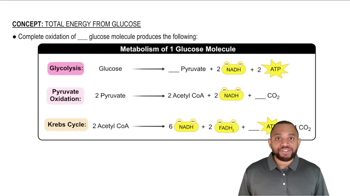
Total Energy From Glucose Concept 1